Custom Search
|
|
 
|
||
|
CHAPTER 1 FACE-TO-FACE CONTACT LEARNING OBJECTIVES Upon completion of this chapter, you should be able to do the following: Discuss the value of face-to-face contact in customer service. Define the terms "customer" "contact point," "skills," and "attitude" as they relate to personal interaction. Determine the correct approach in using the Navy Customer Service Manual. Have you everwaited in line only to be told, when you finally reached the window, "Come back tomorrow; the person responsible for that isn't here"? When trying to get a question answered, have you ever had the feeling that the person you were talking to resented being bothered? Have you ever had to resubmit a request because the original was lost? Are you convinced that there are good reasons (not excuses) for any of the above situations? The Chief of Naval Operations is not, and a great many others in the Navy are not. Only a wishful dreamer would expect all Navy members to be dedicated 100 percent to their work, but only a confirmed pessimist would declare that the Navy is as good as it could be. There must be a point between these two extremes at which those who provide services can handle problems and requests correctly, promptly, and courteously. In other words, there must be a point at which contact point representatives can efficiently satisfy the needs of customers. Everyone in the Navy is directly or indirectly responsible for providing efficient customer service. However, of the many ratings in the Navy, only a few provide direct services to other personnel. These include the AK, DK, DT, HM, LI, LN, MS, NC, PC, PN, RP, SH, SK, and YN ratings. Although the principles given in this manual are intended mainly for personnel in these ratings, those in other ratings can certainly benefit. They can apply these principles daily on and off the job during face-to-face contact with other personnel. Think back to some recent contact you have had with one or more of the personal service ratings. How would you rate the service you received? If you are a member of one of the personal service ratings or perform service-type duties, how do you think your service would be rated by those you serve? Now, let's go one step further. What effect did this good or bad service have on the person served? How do you respond to courteous treatment or efficient action? Or viewing it from the opposite side, how do you respond to a don't care attitude or bad service? Although you can't always provide customers with everything they may request, you can always give them good service. People may request things or services for which they aren't entitled or to which you haven't the authority to grant. In such cases service refers to the quality of your service rather than whether or not you have complied with all of a person's wishes. The runaround, the fast shuffle, or a don't-bother-me response given to an individual needing service indicates one of the following attitudes: The customer isn't important. The customer's request or problem isn't important. The customer doesn't know what he is talking about. The customer doesn't know what he is talking about. I have more important things to do. Many of the people entering the Navy do not have a clear idea of what Navy life is really like. Their perceptions have been influenced by friends, parents, movies, books, and TV; a sense of responsibilit y to their country (patriotism); the glamour of the uniform and tradition; the opportunity to travel; and the desire to make it on their own. They have all been screened and generally are the type of people the Navy wants-intelligent, healthy, and motivated. In general, they have a lot to learn and a need for a lot of maturing. Although their development may require a lot of hard work, they possess a high potential for becoming valuable Navy members. They will become members who value their role and status in the Navy and value the contributions they can make to the Navy and their country. If these people are generally intelligent and motivated, then why the attitude change during their first term of enlistment? What happens during the first 4 years to make them count the days until they will get out? Part of the reason is the demands placed on the Navy member. A special person is needed to handle those demands, and the person who is unable to handle them could never be happy making a career of the Navy. Even so, some members have left the Navy who might have stayed in had they not faced frustrations and disappointments during their first enlistment. Everyone has inconveniences and disappointments to contend with, and everyone expects them. But what people do not expect and should not have to contend with is a lack of service-service that would enable them to cope with everyday demands. Better human relations will not eliminate their inconveniences or disappointments, but can prevent the frustrations resulting from inadequate service. The effect of bad service is much more lasting than the momentary anger or disgust felt by the recipients of that service. Frustration and resentment resulting from bad service often develop into a negative attitude toward the Navy. On the other hand, good service builds a good attitude in customers. Good service is an indication of capable, knowledgeable, and interested workers and a naval service that cares about its members. Naval personnel have special needs resulting from away of life that is quite different from that of civilians.
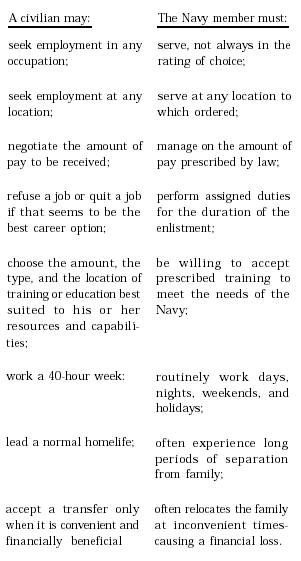
For the Navy to fulfill its mission, members often must sacrifice their freedom of choice to meet the needs of the Navy. They must depend upon the Navy to provide them with training and achievement opportunities as well as challenging and rewarding work experiences. They must also depend upon the Navy to meet their physical and psychological needs. You will probably administer one or more of the medical, financial, educational, and recreational benefits and services the Navy provides its members and their dependents. These benefits and services range from paying costs imposed on members because of transfers to providing opportunities for personal improvement that they otherwise might not have. You must value the importance of these services to Navy members and their families. As a member of a service rating, you are the all-important link between the member and these benefits and services.
For a civilian, several places may offer the same or a similar service. There is usually more than one grocery store, more than one barbershop, more than one service station, more than one laundry, and so forth. But, the situation is very different for the individual in the Navy. There is only one personnel office, one disbursing office, one ship's store, one division office, and so on. While going through the mess line, you probably have heard someone criticize the meal only to be advised, "If you don't like our food, try the restaurant across the street." This advice might have been acceptable if a restaurant had been located across the street-but one wasn't. The person had only one choice: eat what was offered. Of course, not all criticism is valid; sometimes it is merely griping. But this example illustrates the point that most activities normally have only one place where members can go for a specific service. They do NOT have a choice. Since the members do not have a choice, neither do you! Your service is not to be considered a favor. Rather, you are meeting your responsibility. |
 |
|
|
||