Custom Search
|
|
 
|
||
|
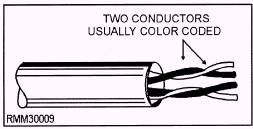
CABLING A data communications network must have cabling to allow individual computers and other peripherals to talk to one another and share resources. And wouldn't it be easier if there were only one type available? There would be fewer hassles when it came time to figure out such things as line speeds, line capacities, variations in line distortion, and so on. However, there area number of types, ranging in cost and capabilities. In the following paragraphs, we examine the advantages and disadvantages of twisted-wire pairs, baseband and broadband coaxial cabling, and fiber optic cabling. Twisted-wire Pairs Twisted-wire pairs, also known as twisted-pair wire or cable, is by far the least expensive transmission media. It consists of two insulated wires twisted around each other so that each wire faces the same amount of interference (noise) from the environment (see fig. 1-9). Unfortunately, this noise becomes part of the signal being transmitted. Twisting the wires together reduces but does not eliminate the noise. Twisted-pair wire comes in a wide range of gauges and pairs. Wire has an American Wire Gauge (AWG) number based on its diameter. For network purposes, 22- and 24-gauge wires are the two most common types of twisted-pair media. Some local-area networks use the same inexpensive, unshielded twisted-pair cables telephone companies use. Others require a higher data grade quality. It's not uncommon to have several hundred pairs (and, in some cases, thousands) of wires placed in a single cable. Normally, each twisted-wire pair in a cable can accommodate a single phone call between two people or between hardware devices. The advantages of using telephone wires are their relative low cost and their availability. Their disadvantages include susceptibility to signal distortion errors and the relatively low transmission rates they provide over long distances. Twisted wire can handle a data flow of up to approximately one megabit per second (Mbps) over several hundred feet. For a small local-area network with a limited number of users, twisted-pair is an ideal choice because it is both inexpensive and easy to install. A phenomenon called
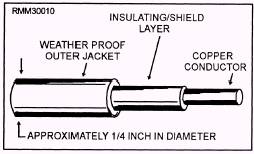
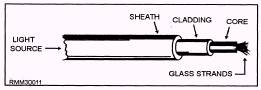
Figure 1-9.\Twisted-wire pairs (2 wire pairs shown). crosstalk exists in twisted-wire pairs whenever transmission occurs at a high rate of speed. Crosstalk is taking place whenever you can hear someone else's conversation in the background; say Mr. Frost telling Mrs. Christmas what a great recipe he has for southern fried chicken, or Mrs. Brush telling Mr. Smith what a large fish she caught in the Gulf of Mexico, while you're trying to carry on a conversation with your party. With voice communications this really isn't a problem; however, crosstalk can inhibit the high-speed transmission required for data communications. Twisted-wire pairs used in data communications are either private or public lines. Private lines are those provided by the user. Public lines are those provided by a common carrier such as American Telephone and Telegraph (AT&T). Generally, public lines are used whenever distances are great or the terrain or other environmental factors prohibit the use of private lines. Public lines may be either switched lines or leased lines. Switched lines are used whenever the amount of data to be transmitted is short in duration or when many locations must be contacted for relatively short periods of time. There is a drawback. The telephone company cannot guarantee you exactly which path or switching equipment such a connection will use. Therefore, the speed and quality of the switched connection are questionable. Leased lines come into play when the connection time between locations A and B is long enough to cover the cost of leasing, or if higher speeds than those available with switched lines must be attained. Leased lines can also be conditioned by the telephone company to lower the error rate and increase transmission speeds. Conditioned leased lines typically operate at speeds of up to 64,000 bits per second (bps). Very-high-speed connections are also available from the common carrier. These are designated T1, T2, T3, and T4, and offer transmission rates of 1.5, 6.3, 46, and 281 million bits per second (Mbps), respectively. Coaxial (or coax) cable, the medium used by most cable television companies, was developed primarily because of the crosstalk in twisted-wire pairs when transmission occurs at a high rate of speed. While coax is more expensive than twisted-pair, it can transmit data significantly faster, over much longer distances, and with less electrical interference. Coaxial cable is made up of one or two central data transmission wires composed of copper surrounded by an insulating layer, a shielding layer, and a weather proof outer jacket, as shown in figure 1-10. It is almost as easy to install as twisted-pair, and is the preferred medium for many of the major local-area networks. Coaxial cable is used extensively in local-area networks whenever the distance involved is relatively short, generally less than 2 miles for baseband LANs and 10 miles for broadband LANs. It is used in both baseband and broadband networks. Wait a minute! You say you want to know what the terms baseband and broadband mean and how they relate to networks? Not to worry; we explain them to you a little later in the text, but for now, all you need to know is that they both deal with the way data is transmitted (in the form of electrical signals) through some type of medium. Fiber Optic Cable Fiber optic cable is to coaxial cable is to twisted-pair as the F-18 Hornet is to the Corvette is to the model T. It is the newest of the communication mediums, one that was spurred by the development of laser technology. Fiber optic cable (shown in fig. 1-11) consists of thousands of clear glass fiber strands, each approximately the thickness of a human hair. Transmission is made possible by the transformation of digital data into modulated light beams, which are sent through the cable by a laser light-emitting diode (LED) type device at incredibly fast speeds. Transmission rates available (as of 1990) range up to approximately 1 billion (or giga) bits per second (Gbps), with speeds over 2 Gbps possible. When thinking in terms of frequencies, light frequencies are extremely high. They are approximately 600,000 times that of the highest television channel. In terms of data communications, the higher the frequency of the signal, the more information it can carry. Put simply, every hairlike fiber within a fiberoptic cable has the capacity to carry many hundreds of local-area network channels simultaneously. When dealing with fiber optic cable, you will hear such terms as:
Figure 1-10.\Coaxial cable,
Figure 1-11.\Fiber optic cable. l Monomode\ Single fiber cable l Multimode\ Several fibers within a cable * Graded index\ A variation of multimode Some of the major advantages of fiber optics over wire media include speed, size, weight, longevity, and resistance to tapping without being noticed. Since it carries no electrical current, it is immune to electrical interference of any kind, and there is no worry of it being a shock hazard. One big disadvantage of fiber optic is the tighter restrictions on how much the cable can be bent. Other disadvantages include higher cost, and the inability to add on new workstations while other stations are active. Although it is relatively easy to splice the fiber optic cable and add new stations, the network or a portion of the network must be down while preparing the splice. On the other hand, if your activity has serious interference problems, or has a need for absolute network security, or the need to send signals several miles, then fiber optics might be the only solution. Cable Selection About now, you may be asking yourself, why all the fuss over transmission speeds? Why not just simply choose the cheapest transmission medium available and use it? It may not be the ideal situation, but it would get the job done, right? This is true; and with that in mind, we ask you this question. Would you put regular unleaded gasoline in your brand new car that happens to have a high-performance engine? The engine may not run as well as you would like, but it would get the job done, right? The same is true of transmission speeds and the different levels of speed within a computer system. To put it another way, the speed of transmission is very much related to the type of transmission medium used between stations in a network. Most computer processing units (CPUs) are able to execute instructions and basic decision-making steps at a rate of several million instructions per second. Data can be transferred between the computer's memory and the cpu at these same rates of speed. The ideal network could keep up with the high speed of the cpu and be able to transfer data between the stations of the network at rates close to the rates that data is moved around within the cpu and memory. However, this is just not possible with a telephone line linked system, which is limited in the range of frequencies it can carry. When high-frequency signals are carried by wire such as twisted-pair, all sorts of electrical effects come into play. It's not sufficient to simply link computer systems with common wire. Considerable thought must be given to the electrical characteristics of the connection. The cable selection must be made during the design phase of the network to ensure that the decision is not left to be made during the installation of the network. |
 |
|
|
||