Custom Search
|
|
 
|
||
|
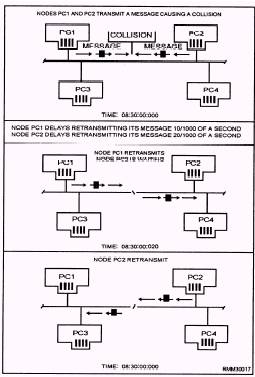
PROTOCOLS Network protocols are an important component; they define how networks establish communications between elements, exchange information, and terminate communications. Protocols have two major operational functions. They establish the circuit for transmission (handshaking) and for the transmission itself. Transmission is conducted subject to the line dicipline. The line discipline is the sequence of operations that actually transmits and receives the data, handles the error-control procedures, handles the sequencing of message blocks, and provides for validation for information received correctly. Two representative protocols, which control line dicipline, are: the Binary Synchronous Communications Protocol (Bisync) and the Synchronous Data Link Control (SDLC). l Bisync is a half-duplex protocol that transmits strings of characters at lower speeds over dial-up circuits. Information movement is one direction at a time, with each data transfer being answered by an acknowledgement. l SDLC is a control procedure that sends multiple blocks of data and returns a single acknowledgement for many blocks, thereby increasing the amount of time spent transmitting data. The bits that are put before and after the message at the transmitting end are removed at the receiving end, so only the message is presented to the user. The hardware chosen for the network plays apart in the choice of network protocol. Most users and many of the vendors that build clone-type equipment would like to see universal interfaces. Others feel that the availability of different specifications will lead to a proprietary set of equipment, even though they favor the overall IS0 specifications (which are covered later in this chapter). ACCESS METHODS Another decision to be made is which access method to use. Access methods are the arrangements used to ensure that each workstation has fair and equal access to the network. The access method that will be used is governed primarily by the network's topology and protocol. The principal access methods are contention and token passing. Contention The contention method features Carrier Sense Multiple Access (CSMA) and Carrier Sense Multiple Access with Collision Detection (CSMA/CD). (See figure 1-6.) Access for both is on "a first-come, first-served basis. The CSMA scheme is very similar to a citizens band (CB) radio. Stations with data to send listen to the channel and wait until it is clear to transmit. With CSMA/CD, if two or more workstations transmit simultaneously, their messages will collide. As soon as a workstation detects a collision, it ceases transmission, monitors the network until it hears no other traffic, and then retransmits. Most contention networks assign a unique retry algorithm to vary the wait-and-retry period. This algorithm reduces the likelihood that after a collision, two workstations will transmit retries simultaneously.
Figure 1-6.\A bus network using the CSMA/CD access method. Token Passing Token passing is an orderly access method (figure 1-7). Each workstation passes on the opportunity to transmit to its closest neighbor, until a station is found with a message to send. This permission to transmit is called a token. When a workstation with data to send is handed a token, part of the token is changed, indicating it is carrying a message, and then data is transmitted with the token. The token is then passed around the network, and every station checks to see if the message is intended for them. The receiving station copies the message from the token but then passes the unchanged token along the network. When the transmitting station receives the same token, it knows the message has been passed around the network. The transmitting station erases the message and puts the empty token back into circulation on the network. The amount of information that may be transmitted during possession of the token is limited so that all workstations can share the cable equally. |
 |
|
|
||