Custom Search
|
|
 
|
||
|
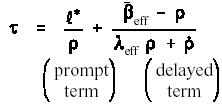
Another new term has been introduced in the reactor period
( If the reactor is operating at a constant power, all the
precursor groups reach an equilibrium value. During an up-power transient,
however, the shorter-lived precursors decaying at any given instant were born
at a higher power level (or flux level) than the longer-lived precursors
decaying at the same instant. There is, therefore, proportionately more of the
shorter-lived and fewer of the longer-lived precursors decaying at that given
instant than there are at constant power. The value of During a down-power transient the longer-lived precursors
become more significant. The longer-lived precursors decaying at a given
instant were born at a higher power level (or flux level) than the
shorter-lived precursors decaying at that instant. Therefore, proportionately
more of the longer-lived precursors are decaying at that instant, and the value
of Approximate values for Returning now to Equation (4-7) for reactor period.
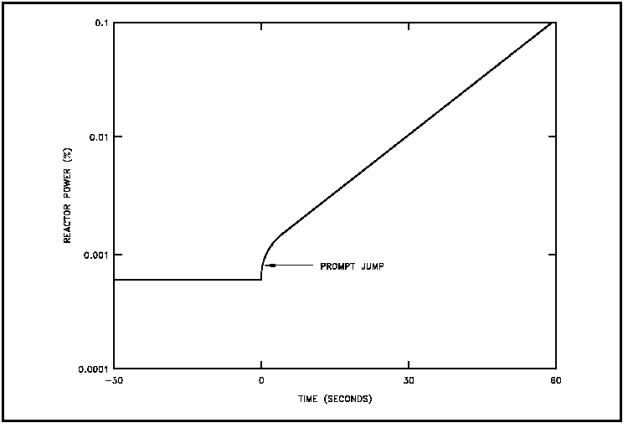
If the positive reactivity added is less than the value of
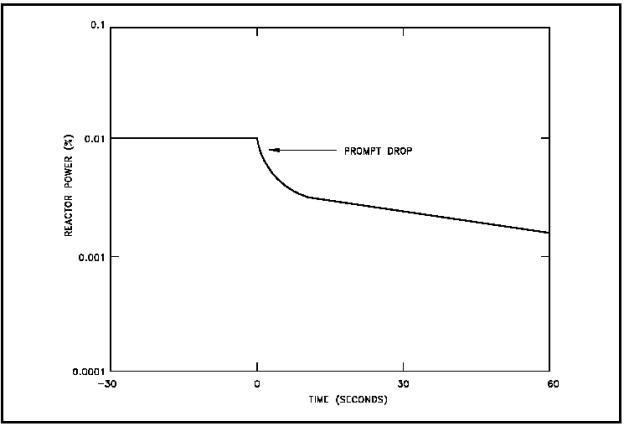
Figure 2 Reactor Power Response to Positive Reactivity Addition Conversely, in the case where negative reactivity is added to the core there will be a prompt drop in reactor power. The prompt drop is the small immediate decrease in reactor power caused by the negative reactivity addition. The prompt drop is illustrated in Figure 3. After the prompt drop, the rate of change of power slows and approaches the rate determined by the delayed term of Equation (4-7).
Figure 3 Reactor Power Response to Negative Reactivity Addition |
 |
|
|
||











 )
)
 eff
eff
 ,
,