

Custom Search
|
|
 
|
||
|
Drop Model of a Nucleus The nucleus is held together by the attractive nuclear force between nucleons, which was discussed in a previous chapter. The characteristics of the nuclear force are listed below. (a) very short range, with essentially no
effect beyond nuclear dimensions (b) stronger than the repulsive electrostatic forces within the nucleus (c) independent of nucleon pairing, in that the attractive forces between pairs of neutrons are no different than those between pairs of protons or a neutron and a proton (d) saturable, that is, a nucleon can attract only a few of its nearest neighbors One theory of fission considers the fissioning of a nucleus similar in some respects to the splitting of a liquid drop. This analogy is justifiable to some extent by the fact that a liquid drop is held together by molecular forces that tend to make the drop spherical in shape and that try to resist any deformation in the same manner as nuclear forces are assumed to hold the nucleus together. By considering the nucleus as a liquid drop, the fission process can be described. Referring to Figure 18(A), the nucleus in the ground state is undistorted, and its attractive nuclear forces are greater than the repulsive electrostatic forces between the protons within the nucleus. When an incident particle (in this instance a neutron) is absorbed by the target nucleus, a compound nucleus is formed. The compound nucleus temporarily contains all the charge and mass involved in the reaction and exists in an excited state. The excitation energy added to the compound nucleus is equal to the binding energy contributed by the incident particle plus the kinetic energy possessed by that particle. Figure 18(B) illustrates the excitation energy thus imparted to the compound nucleus, which may cause it to oscillate and become distorted. If the excitation energy is greater than a certain critical energy, the oscillations may cause the compound nucleus to become dumbbell-shaped. When this happens, the attractive nuclear forces (short-range) in the neck area are small due to saturation, while the repulsive electrostatic forces (long-range) are only slightly less than before. When the repulsive electrostatic forces exceed the attractive nuclear forces, nuclear fission occurs, as illustrated in Figure 18(C).
Figure 18 Liquid Drop Model of Fission Critical Energy The measure of how far the energy level of a nucleus is
above its ground state is called the excitation energy Fissile Material A fissile material is composed of nuclides for which fission is possible with neutrons of any energy level. What is especially significant about these nuclides is their ability to be fissioned with zero kinetic energy neutrons (thermal neutrons). Thermal neutrons have very low kinetic energy levels (essentially zero) because they are roughly in equilibrium with the thermal motion of surrounding materials. Therefore, in order to be classified as fissile, a material must be capable of fissioning after absorbing a thermal neutron. Consequently, they impart essentially no kinetic energy to the reaction. Fission is possible in these materials with thermal neutrons, since the change in binding energy supplied by the neutron addition alone is high enough to exceed the critical energy. Some examples of fissile nuclides are uranium-235, uranium-233, and plutonium-239. Fissionable Material A fissionable
material is composed of nuclides for which fission with neutrons is
possible. All fissile nuclides fall into this category. However, also included
are those nuclides that can be fissioned only with high energy neutrons. The
change in binding energy that occurs as the result of neutron absorption
results in a nuclear excitation energy level that is less than the required
critical energy. Therefore, the additional excitation energy must be supplied
by the kinetic energy of the incident neutron. The reason for this difference
between fissile and fissionable materials is the so-called odd-even effect for
nuclei. It has been observed that nuclei with even numbers of neutrons and/or
protons are more stable than those with odd numbers. Therefore, adding a
neutron to change a nucleus with an odd number of neutrons to a nucleus with an
even number of neutrons produces an appreciably higher binding energy than
adding a neutron to a nucleus already possessing an even number of neutrons.
Some examples of nuclides requiring high energy neutrons to cause fission are
thorium-232, uranium-238, and plutonium-240. Table 4 indicates the critical
energy
|
 |
|
|
||
|
|
Integrated Publishing, Inc. - A (SDVOSB) Service Disabled Veteran Owned Small Business
|












 .
For fission to occur, the excitation energy must be above a particular value
for that nuclide. The
.
For fission to occur, the excitation energy must be above a particular value
for that nuclide. The  is the minimum excitation energy required for
fission to occur.
is the minimum excitation energy required for
fission to occur. and the binding energy change for an added
neutron
and the binding energy change for an added
neutron  to target nuclei of interest. For fission to
be possible, the change in binding energy plus the
to target nuclei of interest. For fission to
be possible, the change in binding energy plus the  .
.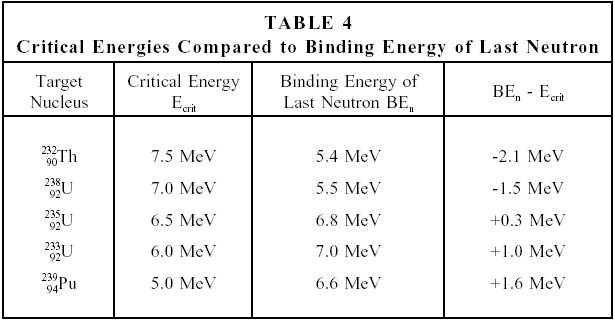 Uranium-235
fissions with thermal neutrons because the binding energy released by the
absorption of a neutron is greater than the critical energy for fission;
therefore uranium-235 is a fissile material. The binding energy released by
uranium-238 absorbing a thermal neutron is less than the critical energy, so
additional energy must be possessed by the neutron for fission to be possible.
Consequently, uranium-238 is a
Uranium-235
fissions with thermal neutrons because the binding energy released by the
absorption of a neutron is greater than the critical energy for fission;
therefore uranium-235 is a fissile material. The binding energy released by
uranium-238 absorbing a thermal neutron is less than the critical energy, so
additional energy must be possessed by the neutron for fission to be possible.
Consequently, uranium-238 is a 