Custom Search
|
|
 
|
||
|
Alpha
decay is the emission of alpha particles (helium nuclei) which
may be represented as either
The combined kinetic energy of the daughter nucleus
(Thorium-230) and the a particle is designated as KE. The sum of the KE and the
gamma energy is equal to the difference in mass between the original nucleus
(Uranium-234) and the final particles (equivalent to the binding energy
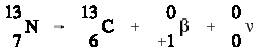
released, since Beta Decav ( Beta decay is the emission of electrons of nuclear rather than orbital origin. These particles are electrons that have been expelled by excited nuclei and may have a charge of either sign. If both energy and momentum are to be conserved, a third
type of particle, the neutrino, v, must be involved. The neutrino is associated
with positive electron emission, and its antiparticle, the antineutrino, Negative electron emission, represented as
Positively charged electrons (beta-plus) are known as
positrons. Except for sign, they are nearly identical to their negatively
charged cousins. When a positron, represented as
|
 |
|
|
||
|
|
Integrated Publishing, Inc. - A (SDVOSB) Service Disabled Veteran Owned Small Business
|













 m
=
m
= 
 ,
,  or simply as


 ,
is ejected from the nucleus, the atomic number is decreased by one and the mass
number remains unchanged. A proton has been converted to a
,
is ejected from the nucleus, the atomic number is decreased by one and the mass
number remains unchanged. A proton has been converted to a