Custom Search
|
|
 
|
||
|
This chapter covers determining and calculating the slope of a line. EO 1.14 STATE the definition of the following terms: a. Slope b. Intercept EO 1.15 Given the equation, CALCULATE the slope of a line. EO 1.16 Given the graph, DETERMINE the slope of a line. Many physical relationships in science and engineering may be expressed by plotting a straight line. The slope(m), or steepness, of a straight line tells us the amount one parameter changes for a certain amount of change in another parameter. Slope For a straight line, slope is equal to rise over run, or
Consider
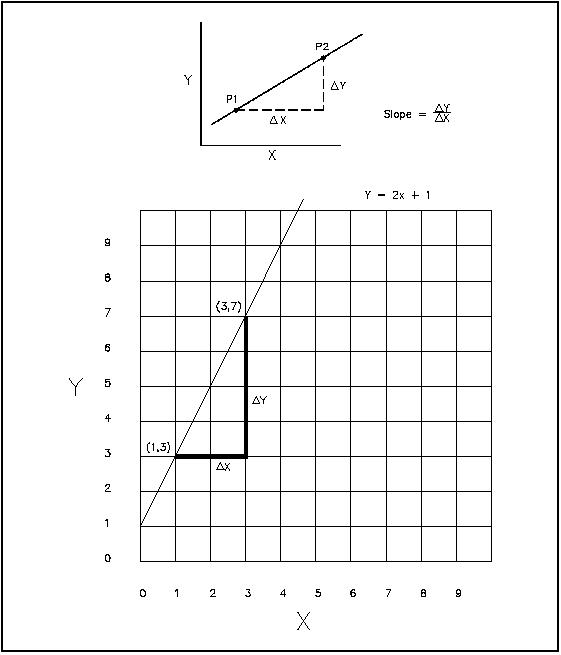
the curve shown in Figure 11. Points P1 and P2 are any two different points on
the line, and a right triangle is drawn whose legs are parallel to the
coordinate axes. The length of the leg parallel to the x-axis is the difference
between the x-coordinates of the two points and is called "
Figure 11 Slope Since slope m is a measure of the steepness of a line, a slope has the following characteristics: 1. A horizontal line has zero slope. 2. A line that rises to the right has positive slope. 3. A line rising to the left has negative slope. 4. A vertical line has undefined slope
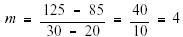
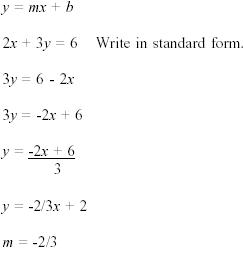
because the calculation of the slope would involve division by zero. ( Example: What is the slope of the line passing through the points (20, 85) and (30, 125)? Solution: Given the coordinates of the y-intercept where the line crosses the y-axis [written (0, y)] and the equation of the line, determine the slope of the line. The standard linear equation form is y = mx + b. If an equation is given in this standard form, m is the slope and b is the y coordinate for the y-intercept. Example: Determine the slope of the line whose equation is y = 2x + 3 and whose y-intercept is (0,3). Solution: y = mx + b y=2x+3 m=2 Example: Determine the slope of the line whose equation is 2x + 3y = 6 and whose y-intercept is (0,2). Solution:
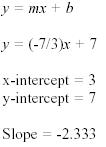
Example: Plot the graph of the following linear function. Determine the x-intercept, the y-intercept, and the slope. 7x+3y=21 Solution:
Summary The important information in this chapter is summarized below. Slopes Summary For a straight line, slope is equal to rise over run, or
Since slope m is a measure of the steepness of a line, a slope has the following characteristics: 1. A horizontal line has zero slope. 2. A line that rises to the right of vertical has positive slope. 3. A line rising to the left of vertical has negative slope. 4. A vertical line has undefined slope
because the calculation of the slope would involve division by zero (
|
 |
|
|
||
|
|
Integrated Publishing, Inc. - A (SDVOSB) Service Disabled Veteran Owned Small Business
|












 x,"
read "delta x," or "the change in x." The leg parallel to
the y-axis has length Ay, which is the difference between the y-coordinates.
For example, consider the line containing points (1,3) and (3,7) in the second
part of the figure. The difference between the x-
x,"
read "delta x," or "the change in x." The leg parallel to
the y-axis has length Ay, which is the difference between the y-coordinates.
For example, consider the line containing points (1,3) and (3,7) in the second
part of the figure. The difference between the x-