Custom Search
|
|
 
|
||
|
Channeling is a condition in which the resin allows a direct flow of water through the ion exchanger. Flow channels are established from the inlet to the outlet of the ion exchanger, which allows water to flow essentially unrestricted through the resin via these paths. If channeling occurs, the water flowing through the resin bed has insufficient contact with the resin beads and results in a decrease in effectiveness of the ion exchanger. Channeling most often results from improper filling of the ion exchanger with resin. If insufficient water is mixed with the resin when it is added, the resin column may contain pockets, or voids. These voids may then set up flow paths for channeling to occur. Improper design or malfunction of the water inlet connection (flow diffuser) can also lead to channeling. Breakthrough and Exhaustion To
gain further insight into the processes that occur in a column of mixed bed
resin as it removes an impurity, it is worthwhile to construct a series of curves
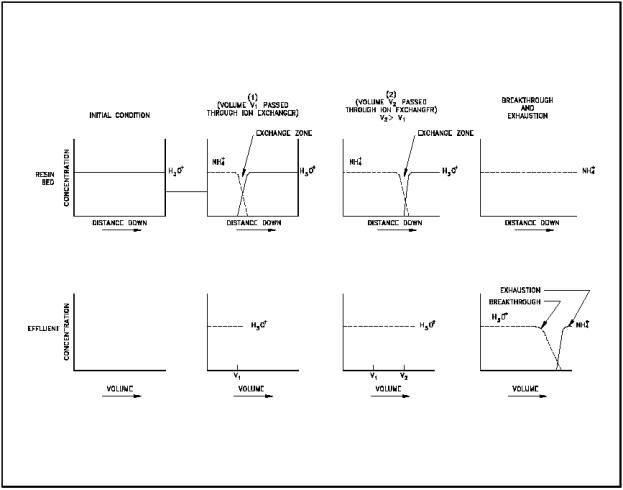
such as those shown in Figure 6. These curves illustrate the behavior of
hydrogen form resin as it removes In
the bottom row, concentration is plotted against volume of solution that has
passed through the column. That is, the plots represent the concentration of
the indicated ion in the effluent solution after a volume of solution has
passed through the resin. It is assumed that the concentration of
Figure 6 Behavior of Hydrogen Form Cation Exchange Bed as it Removes Ammonium Ions from Solution As solution passes through the resin column, the relative
amounts of ammonium and hydrogen ions on the resin change. The actual exchange
process occurs primarily in a relatively narrow band of the column rather than
over the entire length. This band is called the exchange zone. Assuming the
column is vertical and that solution flows from top to bottom, the resin above
the exchange zone is depleted; that is, practically all the exchange capacity
has been used. Below the exchange zone, essentially none of the resin's
exchange capacity has been used. As more and more solution flows through the
column, the exchange zone gradually moves downward as more of the resin is depleted.
Eventually, as the exchange zone approaches the end of the column, small
amounts of
|
 |
|
|
||












 ions from solution (the behavior of an anion
resin is analogous). The two rows of curves schematically represent the
concentrations of H+ and
ions from solution (the behavior of an anion
resin is analogous). The two rows of curves schematically represent the
concentrations of H+ and  on the resin and in the effluent (exiting
solution).
on the resin and in the effluent (exiting
solution). in the influent is constant.
  ions are more strongly attracted to the resin
than are H+ ions. Thus,
ions are more strongly attracted to the resin
than are H+ ions. Thus,  ions readily exchange for H+ ions on the
resin.
ions readily exchange for H+ ions on the
resin.