Custom Search
|
|
  |
|
|
Catapult Firing and Initial Seat Movement
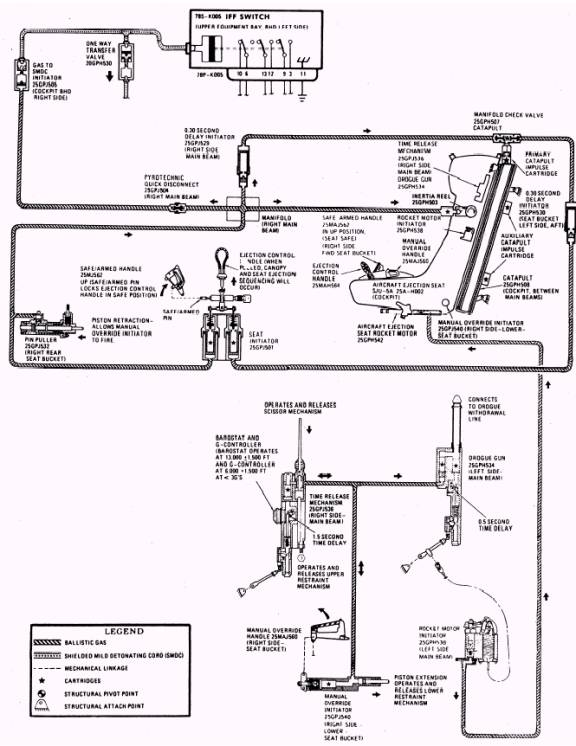
Ballistic gas pressure developed by the cat-apult primary cartridge causes the inner and intermediate barrels within the catapult to rise and release the top latch mechanism. The secondary cartridges within the catapult fire progressively as the rising barrels are exposed to the heat and pressure of the primary cartridge gas. Progressive firing of the catapult secondary cartridges provides a relatively even gas pressure during catapult extension. This eliminates excessive g-forces during ejection. As the seat moves upward, the emergency oxygen system is activated. A trip rod withdraws the firing link from the drogue gun and starts a 0.5-second internal timer. Another trip rod withdraws the firing link from the time-release mechanism. Aircraft electrical power and personal services (oxygen and communication) between the seat and the aircraft are disconnected. At this point in the sequence, the leg restraint lines are drawn through the snubbing units to restrain the pilot's legs to the seat bucket. When the leg restraint lines become taut, the upper portion of the leg restraint line shears from the lower portion, which is attached to the floor bracket. Forward movement of the lines is prevented by the snubbing units. After 72 inches of catapult extension, the rocket motor initiator is fired by a cable that is attached to the drogue gun trip rod. Ballistic gas pressure generated by the cartridge within the rocket motor initiator is routed to a pressure actuated firing mechanism located on the rocket motor. Flame and pressure ignite the rocket motor propellant grain. The thrust of the motor is approximately 4,500 pounds and lasts for 0.25 second. Aircraft and Seat Separation Separation of the seat from the aircraft occurs at approximately 76 inches of catapult extension. At this point, the inner barrel separates from the intermediate barrel. The seat is now clear of the aircraft. The drogue gun primary cartridge fires after a 0.5-second delay to propel the piston from the drogue gun barrel. The inertia of the piston extracts the parachute flap closure pin and deploys the 22-inch controller drogue. The controller drogue, in turn, deploys the 60-inch stabilization and retardation drogue. The 0.5-second time delay allows the seat to reach its maximum altitude before the drogues are fully developed. The seat will stabilize and decelerate because of the drogues, which are held to the seat by the scissor mechanism. If the drogue gun primary cartridge fails to fire, ballistic gas pressure will pass to the drogue gun when the time-release mechanism (TRM) fires. This gas shears the firing pin retaining pin. The firing pin then strikes the secondary drogue gun cartridge, which results in drogue deploy-ment. Should both the drogue gun primary and time-release mechanism cartridges fail to fire, operation of the manual override handle will fire
Figure 6-19.- Ejection seat sequencing schematic. the manual override initiator cartridge. This duplicates the function of the TRM and fires the drogue gun secondary cartridge. The drogue gun then deploys the drogue parachutes and personnel parachute concurrently. The TRM altitude-sensing barostatic time release prevents the 1.5-second timer from starting at altitudes above 11,500 feet. The barostatic time release ensures that the pilot descends rapidly through the upper atmosphere to a more survivable altitude. At altitudes between 7,500 and 11,500 feet, the time delay for deployment of the personnel parachute is con-trolled by an internal g-limiter, which interrupts the timing sequence until the deceleration force is less than 1.5 g's. This results in lower parachute opening loads. At altitudes below 7,500 feet, the 1.5-second timer starts without interruption. After the 1.5-second timer delay, the TRM cartridge fires. This releases the upper restraint mechanism, lower restraint mechanism, parachute mechanical lock, and drogue shackle. When the drogue is free from the scissor mechanism, it deploys the personnel parachute. The personnel parachute lifts the pilot and the survival kit from the seat and pulls the sticker-clip strap lugs from their clips. This is necessary to ensure that collision between the seat and the pilot is avoided. The radio beacon activates when pilot and seat separation occurs. Then a normal parachute descent begins. While descending in the parachute, the pilot can pull the survival kit handle to separate the kit halves. This allows deployment and automatic inflation of the life raft. The life raft and survival kit items are connected by a lanyard to the survival kit lid, which is attached to the pilot.
|
 |
|
|