Custom Search
|
|
 
|
||
|
SENSITOMETRY In the Photography (Basic), NAVEDTRA 12700, training manual, the quality of the photographic product was judged only from its visual aspects. As a further step, you should know of other controlled working methods and techniques that ensure photographic quality. This area of control, or sensitometry, is one method of using certain photographic theories to improve photographs while saving time, effort, and materials. With sensitometry, variations from the standard and recommended corrections are expressed in numbers and not in terms of personal opinion. Sensitometry provides a permanent record of the process and indicates whether the system was in control when a given film or paper was processed The accumulated data is helpful for determining the cause of poor quality and the exact amount of deviation from the standard. The first requirement in photographic quality assurance is establishing a standard for good processing and the range or limit that quality should not exceed. The standard is based on developing the same film or paper that is given a known exposure and comparing the resulting densities. Black-and-white processing is discussed first in the following paragraphs.
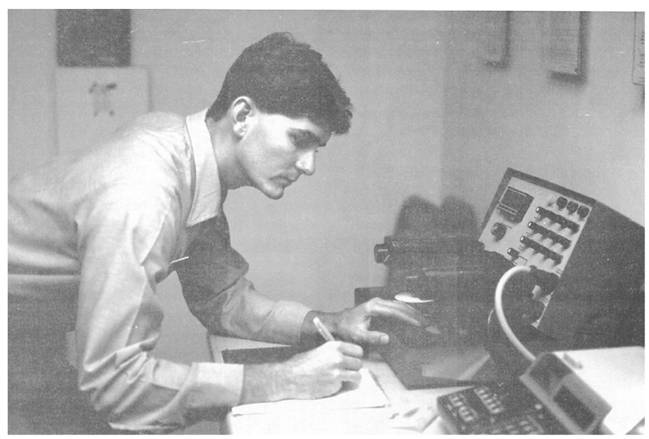
Figure 2-1.-A Photographer's Mate uses a densitometer to read a control strip. Since it would be impossible to judge whether densities are reproduced accurately by viewing your normal production products, special test strips, or control strips, are prepared. The test strips are exposed accurately with varying amounts of light. These test strips are developed in your process, and the resulting densities are read on a densitometer and averaged togethe (fig 2-1). The densities are then plotted on a graph. The plot of the data establishes the standard. Similar test strips are then processed at regular intervals and compared with the standard to ensure that the processing is under control. This, basically, is sensitometry. Another term used in conjunction with sensitometry is densitometry. Densitometry is an integral part of sensitometry. These two terms are often used together or interchangeably. Technically, however, there are differences between them. The differences are as follows: Sensitometry, or measurement of photographic sensitivity, is the science of determining the photographic characteristics of light-sensitive materials. Densitometry, or measurement of densities, is the method whereby data are obtained for sensitometric calculations. Measurements of densities are done on a logarithmic scale. To understand sensitometry, you must become acquainted with logarithms. |
 
|
|
|
||