Custom Search
|
|
  |
|
|
OPTICAL DETECTORS AND FIBER OPTIC RECEIVERS LEARNING OBJECTIVES Upon completion of this chapter, you should be able to do the following:
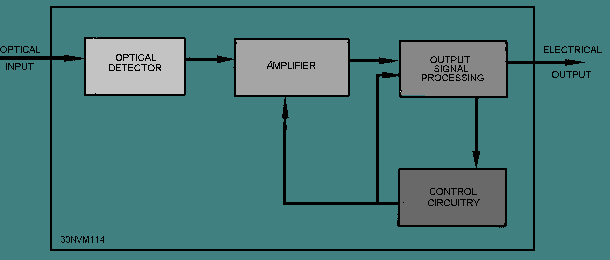
INTRODUCTION TO OPTICAL DETECTORS AND FIBER OPTIC RECEIVERS Chapter 6 taught you that a fiber optic transmitter is an electro-optic device capable of accepting electrical signals, converting them into optical signals, and launching the optical signals into an optical fiber. The optical signals propagating in the fiber become weakened and distorted because of scattering, absorption, and dispersion. The fiber optic device responsible for converting the weakened and distorted optical signal back to an electrical signal is a fiber optic receiver. A fiber optic receiver is an electro-optic device that accepts optical signals from an optical fiber and converts them into electrical signals. A typical fiber optic receiver consists of an optical detector, a low-noise amplifier, and other circuitry used to produce the output electrical signal (see figure 7-1). The optical detector converts the incoming optical signal into an electrical signal. The amplifier then amplifies the electrical signal to a level suitable for further signal processing. The type of other circuitry contained within the receiver depends on what type of modulation is used and the receiver electrical output requirements. Figure 7-1. - Block diagram of a typical fiber optic receiver.
Receiver spectral response, sensitivity, Frequency response, and dynamic range are key receiver performance parameters that can affect overall system operation. The choice of optical detector materials and structures determines the spectral response. Silicon (Si), gallium arsenide (GaAs), and gallium aluminum arsenide (GaAlAs) are typical detector materials used for receiver operation in the 850-nm wavelength region. germanium (Ge), indium phosphide (InP), and indium gallium arsenide (InGaAs) are examples of detector materials used for receiver operation in the 1300-nm and 1550-nm wavelength regions. The receiver sensitivity is the minimum amount of optical power required to achieve a specific receiver performance. For digital transmission at a given data rate and coding, this performance is described by a maximum bit-error rate (BER). In analog systems, for a given modulation and bandwidth, it is described by a minimum signal-to-noise ratio (SNR). Dynamic range refers to the range of optical power levels over which the receiver operates within the specified values. It usually is described by the ratio of the maximum input power to the sensitivity. Before discussing receiver sensitivity, bandwidth, dynamic range, and Frequency response in more detail, we discuss the main types of optical detectors used in fiber optics. Q.1 What is a fiber optic receiver? |
 
|
|
|
Integrated Publishing, Inc. - A (SDVOSB) Service Disabled Veteran Owned Small Business
|