Custom Search
|
|
  |
|
|
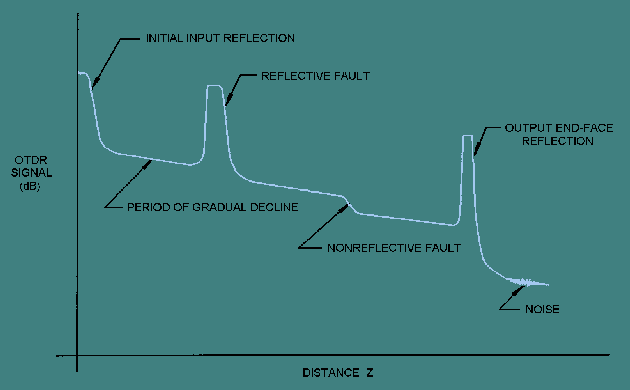
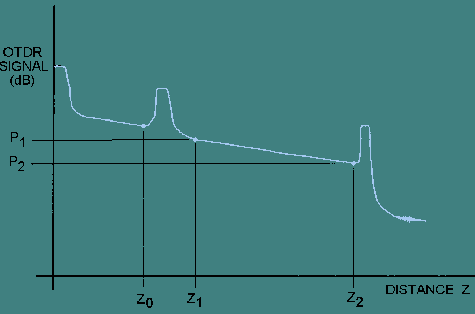
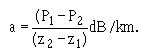
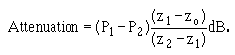
Optical Time-Domain Reflectometry End users use optical time-domain reflectometry to characterize optical fiber and optical connection properties in the field. In optical time-domain reflectometry, an OTDR transmits an optical pulse through an installed optical fiber. The OTDR measures the fraction of light that is reflected back due to Rayleigh scattering and Fresnel reflection. By comparing the amount of light scattered back at different times, the OTDR can determine fiber and connection losses. When several fibers are connected to form an installed cable plant, the OTDR can characterize optical fiber and optical connection properties along the entire length of the cable plant. A fiber optic cable plant consists of optical fiber cables, connectors, splices, mounting panels, jumper cables, and other passive components. A cable plant does not include active components such as optical transmitters or receivers. The OTDR displays the backscattered and reflected optical signal as a function of length. The OTDR plots half the power in decibels (dB) versus half the distance. Plotting half the power in dB and half the distance corrects for round trip effects. By analyzing the OTDR plot, or trace, end users can measure fiber attenuation and transmission loss between any two points along the cable plant. End users can also measure insertion loss and reflectance of any optical connection. In addition, end users use the OTDR trace to locate fiber breaks or faults. Figure 5-13 shows an example OTDR trace of an installed cable plant. OTDR traces can have several common characteristics. An OTDR trace begins with an initial input pulse. This pulse is a result of Fresnel reflection occurring at the connection to the OTDR. Following this pulse, the OTDR trace is a gradual downsloping curve interrupted by abrupt shifts. Periods of gradual decline in the OTDR trace result from Rayleigh scattering as light travels along each fiber section of the cable plant. Periods of gradual decline are interrupted by abrupt shifts called point defects. A point defect is a temporary or permanent local deviation of the OTDR signal in the upward or downward direction. Point defects are caused by connectors, splices, or breaks along the fiber length. Point defects, or faults, can be reflective or nonreflective. An output pulse at the end of the OTDR trace indicates the end of the fiber cable plant. This output pulse results from Fresnel reflection occurring at the output fiber-end face. Figure 5-13. - OTDR trace of an installed cable plant. ATTENUATION. - The fiber optic test method for measuring the attenuation of an installed optical fiber using an OTDR is EIA/TIA-455-61. The accuracy of this test method depends on the user entering the appropriate source wavelength, pulse duration, and fiber length (test range) into the OTDR. In addition, the effective group index of the test fiber is required before the attenuation coefficient and accurate distances can be recorded. The group index (N) is provided by fiber manufacturers or is found using EIA/TIA-455-60. By entering correct test parameters, OTDR fiber attenuation values will closely coincide with those measured by the cutback technique. Test personnel can connect the test fiber directly to the OTDR or to a dead-zone fiber. This dead-zone fiber is placed between the test fiber and OTDR to reduce the effect of the initial reflection at the OTDR on the fiber measurement. The dead-zone fiber is inserted because minimizing the reflection at a fiber joint is easier than reducing the reflection at the OTDR connection. Figure 5-14 illustrates the OTDR measurement points for measuring the attenuation of the test fiber using a dead-zone fiber. Fiber attenuation between two points along the test fiber is measured on gradual downsloping sections on the OTDR trace. There should be no point defects present along the portion of fiber being tested. Figure 5-14. - OTDR measurement points for measuring fiber attenuation using a dead-zone fiber. OTDRs are equipped with either manual or automatic cursors to locate points of interest along the trace. In figure 5-14, a cursor is positioned at a distance zo on the rising edge of the reflection at the end of the dead-zone fiber. Cursors are also positioned at distances z1 and z2. The cursor positioned at z1 is just beyond the recovery from the reflection at the end of the dead-zone fiber. Since no point defects are present in figure 5-14, the cursor positioned at z2 locates the end of the test fiber. Cursor z2 is positioned just before the output pulse resulting from Fresnel reflection occurring at the end of the test fiber. The attenuation of the test fiber between points z1 and z2 is (P1 - P2) dB. The attenuation coefficient (α) is
The total attenuation of the fiber including the dead zone after the joint between the dead-zone fiber and test fiber is
If fiber attenuation is measured without a dead-zone fiber, z0 is equal to zero (z0 = 0). At any point along the length of fiber, attenuation values can change depending on the amount of optical power backscattered due to Rayleigh scattering. The amount of backscattered optical power at each point depends on the forward optical power and its backscatter capture coefficient. The backscatter capture coefficient varies with length depending on fiber properties. Fiber properties that may affect the backscatter coefficient include the refractive index profile, numerical aperture (multimode), and mode-field diameter (single mode) at the particular measurement point. The source wavelength and pulse width may also affect the amount of backscattered power. By performing the OTDR attenuation measurement in each direction along the test fiber, test personnel can eliminate the effects of backscatter variations. Attenuation measurements made in the opposite direction at the same wavelength (within 5 nm) are averaged to reduce the effect of backscatter variations. This process is called bidirectional averaging. Bidirectional averaging is possible only if test personnel have access to both fiber ends. OTDR attenuation values obtained using bidirectional averaging should compare with those measured using the cutback technique in the laboratory.
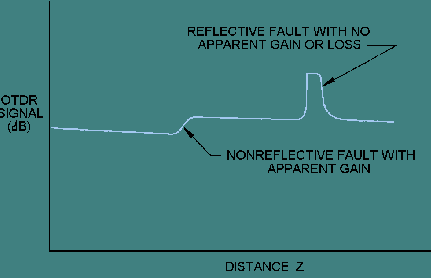
POINT DEFECTS. - Point defects are temporary or local deviations of the OTDR signal in the upward or downward direction. A point defect, or fault, can be reflective or nonreflective. A point defect normally exhibits a loss of optical power. However, a point defect may exhibit an apparent power gain. In some cases, a point defect can even exhibit no loss or gain. Refer back to figure 5-13; it illustrates a reflective fault and a nonreflective fault, both exhibiting loss. Figure 5-15 shows a nonreflective fault with apparent gain and a reflective fault with no apparent loss or gain. Figure 5-15. - An OTDR trace showing a nonreflective fault with apparent gain and a reflective fault with no apparent loss or gain.
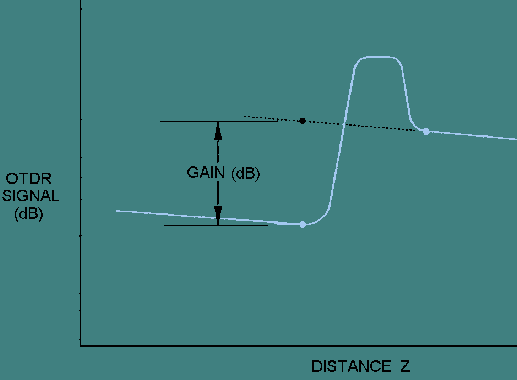
Point defects are located and measured using EIA/TIA-455-59. Test personnel must enter the appropriate input parameters including the source wavelength, the pulse duration, and the fiber or cable group index into the OTDR. The nature of fiber point defects depends on the value of each parameter entered by the end user. The pulse duration usually limits the length of the point defect while other input parameters, such as the wavelength, can vary its shape. If the length of the fiber point defect changes with the pulse duration, then the OTDR signal deviation is in fact a point defect. If the length remains the same, then the OTDR signal deviation is a region of high fiber attenuation. Regions of high fiber attenuation are referred to as attenuation non-uniformities. Fiber point defects occur from factory fiber splices or bends introduced during cable construction or installation. For shipboard applications, manufacturers are not allowed to splice fibers during cable construction. Fiber joints are natural sources of OTDR point defects. However, fiber breaks, cracks, or microbends introduced during cable installation are additional sources of point defects. Point defects that occur at fiber joints are relatively easy to identify because the location of a fiber joint is generally known. A reflective or nonreflective fault occurs at a distance equal to fiber joint location. In most circumstances, an optical connector produces a reflective fault, while an optical splice produces a nonreflective fault. Reflective and nonreflective faults occurring at distances other than fiber joint locations identify fiber breaks, cracks, or microbends. A fiber break produces a reflective fault because fiber breaks result in complete fiber separation. Fiber cracks and microbends generally produce nonreflective faults. A point defect may exhibit apparent gain because the backscatter coefficient of the fiber present before the point defect is higher than that of the fiber present after. Test personnel measure the signal loss or gain by positioning a pair of cursors, one on each side of the point defect. Figure 5-16 illustrates the positioning of the cursors for a point defect showing an apparent signal gain. The trace after the point defect is extrapolated as shown in figure 5-16. The vertical distance between the two lines in figure 5-16 is the apparent gain of the point defect. Figure 5-16. - Extrapolation for a point defect showing an apparent signal gain.
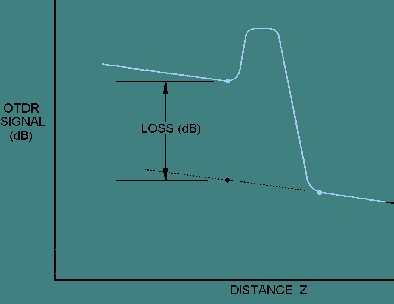
Point defects exhibiting gain in one direction will exhibit an exaggerated loss in the opposite direction. Figure 5-17 shows the apparent loss shown by the OTDR for the same point defect shown in figure 5-16 when measured in the opposite direction. Bidirectional measurements are conducted to cancel the effects of backscatter coefficient variations. Bidirectional averaging combines the two values to identify the true signal loss. Bidirectional averaging is possible only if test personnel have access to both ends of the test sample. Figure 5-17. - The exaggerated loss obtained at point defects exhibiting gain in one direction by conducting the OTDR measurement in the opposite direction.
OTDRs can also measure the return loss of a point defect. However, not all OTDRs are configured to make the measurement. To measure the return loss of a point defect, the cursors are placed in the same places as for measuring the loss of the point defect. The return loss of the point defect is displayed when the return loss option is selected on the OTDR. The steps for selecting the return loss option depend upon the OTDR being used. Q.27 An OTDR measures the fraction of light that is reflected back from the fiber or
link under test. What causes light to be reflected back into the OTDR? |
|