Custom Search
|
|
  |
|
|
REFLECTION LOSSES When optical fibers are connected, optical power may be reflected back into the source fiber. Light that is reflected back into the source fiber is lost. This reflection loss, called Fresnel reflection, occurs at every fiber interface. Fresnel reflection is caused by a step change in the refractive index that occurs at the fiber joint. In most cases, the step change in refractive index is caused by the ends of each fiber being separated by a small gap. This small gap is usually an air gap. In Fresnel reflection, a small portion of the incident light is reflected back into the source fiber at the fiber interface. The ratio (R), shown below, approximates the portion of incident light (light of normal incidence) that is reflected back into the source fiber.
R is the fraction of the incident light reflected at the fiber n1 is the refractive index of the fiber core. n0 is the refractive index of the medium between the two fibers. Fresnel refraction occurs twice in a fiber-to-fiber connection. A portion of the optical power is reflected when the light first exits the source fiber. Light is then reflected as the optical signal enters the receiving fiber. Fresnel reflection at each interface must be taken into account when calculating the total fiber-to-fiber coupling loss. Loss from Fresnel reflection may be significant. To reduce the amount of loss from Fresnel reflection, the air gap can be filled with an index matching gel. The refractive index of the index matching gel should match the refractive index of the fiber core. Index matching gel reduces the step change in the refractive index at the fiber interface, reducing Fresnel reflection. In any system, index matching gels can be used to eliminate or reduce Fresnel reflection. The choice of index matching gels is important. Fiber-to-fiber connections are designed to be permanent and require no maintenance. Over the lifetime of the fiber connection, the index matching material must meet specific optical and mechanical requirements. Index matching gels should remain transparent. They should also resist flowing or dripping by remaining viscous. Some index matching gels darken over time while others settle or leak out of fiber connections. If these requirements are not met, then the fiber-to-fiber connection loss will increase over time. In Navy applications, this variation in connection loss over time is unacceptable. In Navy systems, index matching gels are only used in fiber optic splice interfaces. Q.5 In fiber-to-fiber connections, Fresnel reflection is one source of coupling losses.
Light is reflected back into the source fiber and is lost. What causes Fresnel reflection?
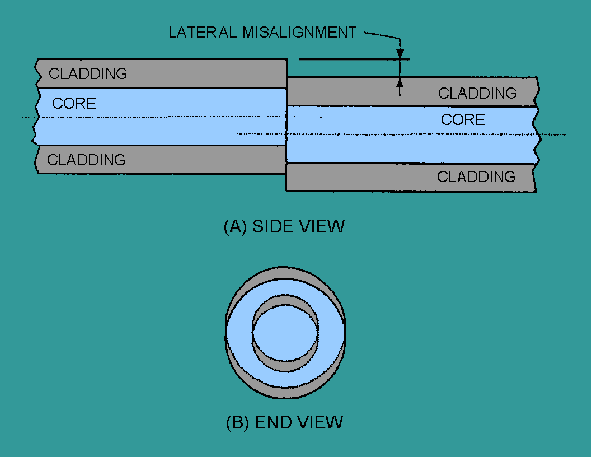
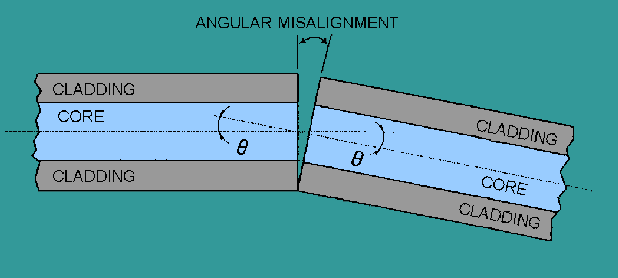
FIBER ALIGNMENT A main source of extrinsic coupling loss in fiber-to-fiber connections is poor fiber alignment. The three basic coupling errors that occur during fiber alignment are fiber separation (longitudinal misalignment), lateral misalignment, and angular misalignment. Most alignment errors are the result of mechanical imperfections introduced by fiber jointing techniques. However, alignment errors do result from installers not following proper connection procedures. With fiber separation, a small gap remains between fiber-end faces after completing the fiber connection. Figure 4-2 illustrates this separation of the fiber-end faces. Figure 4-2. - Fiber separation. Lateral, or axial, misalignment occurs when the axes of the two fibers are offset in a perpendicular direction. Figure 4-3 shows this perpendicular offset of the axes of two connecting fibers. Figure 4-3. - Lateral misalignment. Angular misalignment occurs when the axes of two connected fibers are no longer parallel. The axes of each fiber intersect at some angle (Θ). Figure 4-4 illustrates the angular misalignment between the core axes. Figure 4-4. - Angular misalignment. Coupling loss caused by lateral and angular misalignment typically is greater than the loss caused by fiber separation. Loss, caused by fiber separation, is less critical because of the relative ease in limiting the distance of fiber separation. However, in some cases, fiber optic connectors prevent fibers from actual contact. These fiber optic connectors separate the fibers by a small gap. This gap eliminates damage to fiber-end faces during connection. For connectors with an air gap, the use of index matching gel reduces the coupling loss. Most newer connectors are designed so that the connector ferrule end faces contact when the connector is mated. The connector can be assembled onto the fiber so that the fibers also contact when mated. However, they also can be assembled so that the fibers do not. Whether or not the fibers contact is determined by whether the fiber sticks out slightly from the ferrule or is recessed inside the ferrule. The fiber position can be controlled by the connector polishing technique. The physical contact (PC) polish technique was developed for most connectors so that the fibers would touch when mated. In these types of connectors, index gel is not needed to reduce reflections. While index matching gel reduces coupling loss from fiber separation, it does not affect loss in lateral misalignment. Additionally, index matching gel usually increases the fiber's coupling loss sensitivity to angular misalignment. Although angular misalignment involves fiber separation, index matching gel reduces the angle at which light is launched from the source fiber. Index matching gel causes less light to be coupled into the receiving fiber. To reduce coupling loss from angular misalignment, the angle Θ should be less than 1. Coupling losses due to fiber alignment depend on fiber type, core diameter, and the distribution of optical power among propagating modes. Fibers with large NAs reduce loss from angular misalignment and increase loss from fiber separation. Single mode fibers are more sensitive to alignment errors than multimode fibers because of their small core size. However, alignment errors in multimode fiber connections may disturb the distribution of optical power in the propagating modes, increasing coupling loss. Q.7 List the three basic errors that occur during fiber alignment. |
|