Custom Search
|
|
  |
|
|
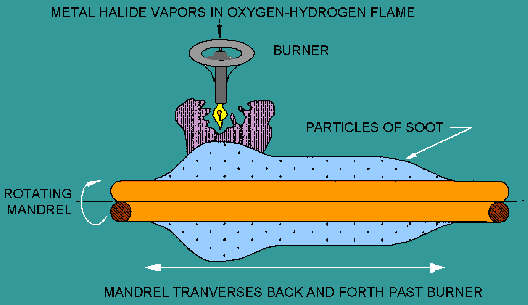
FABRICATION OF OPTICAL FIBERS Basically, fiber manufacturers use two methods to fabricate multimode and single mode glass fibers. One method is vapor phase oxidation, and the other method is direct-melt process. In vapor phase oxidation, gaseous metal halide compounds, dopant material, and oxygen are oxidized (burned) to form a white silica powder (SiO2). Manufacturers call SiO2 the soot. Manufacturers deposit the soot on the surface of a glass substrate (mandrel) or inside a hollow tube by one of the following three methods: The soot forms the core and cladding material of the preform. The refractive index of each layer of soot is changed by varying the amount of dopant material being oxidized. Figures 3-8, 3-9, and 3-10 illustrate the different vapor phase oxidation preform preparation methods. Figure 3-8. - OVPO preform preparation. Figure 3-9. - IVPO preform preparation. Figure 3-10. - VAD preform preparation. During vapor phase oxidation, the mandrel or tube continuously moves from side to side and rotates while soot particles are deposited on the surface. This process forms cylindrical layers of soot on the surface of the mandrel or inside the hollow tube. This deposited material is transformed into a solid glass preform by heating the porous material (without melting). The solid preform is then drawn or pulled into an optical fiber by a process called fiber drawing. The fiber drawing process begins by feeding the glass preform into the drawing furnace. The drawing furnace softens the end of the preform to the melting point. Manufacturers then pull the softened preform into a thin glass filament (glass fiber). To protect the bare fiber from contaminants, manufacturers add an acrylate coating in the draw process. The coating protects the bare fiber from contaminants such as atmospheric dust and water vapor. Figure 3-11 illustrates the process of drawing an optical fiber from the preform. Figure 3-11. - Fiber drawing process. In the direct-melt process, multicomponent glass rods form the fiber structure. Rods of multicomponent glass combine in a molten state to form the fiber core and cladding. The double-crucible method is the most common direct-melt process. The double-crucible method combines the molten rods into a single preform using two concentric crucibles. Optical fibers are drawn from this molten glass using a similar fiber drawing process as in vapor phase oxidation. Figure 3-12 illustrates the double-crucible drawing process. Figure 3-12. - Double-crucible fiber drawing process. Q.24 What are the two methods used by fiber manufacturers to fabricate multimode and
single mode glass fibers? |
 |