|
ANSWERS TO QUESTIONS Q1. THROUGH Q50.
A1. Two inputs, two outputs.
A2. Common emitter (CE) and common base (CB).
A3. No output (the signals will "cancel out").
A4. Equal in shape and frequency to each input signal and larger in amplitude by two times
than either input signal.
A5. Equal in shape and frequency to the input signal; larger in amplitude than the input
signal; half as large in amplitude as when two input signals were used that were 180
degrees out of phase.
A6. A different shape than the input signals but larger in amplitude.
A7. 100 millivolts.
A8. Each output will be a sine wave with a peak-to-peak amplitude of 100 millivolts. The
output signals will be 180 degrees out of phase with each other.
A9. 200 millivolts.
A10. 0 volts (the input signals will "cancel out").
A11. Each output signal will be 100 millivolts.
A12. 180 degrees out of phase with each other. Output signal number one will be in phase
with input signal number two; output signal number two will be in phase with input signal
number one.
A13. 200 millivolts.
A14. 100 millivolts. No.
A15. Very high gain, very high input impedance, very low output impedance.
A16. An integrated circuit (chip).
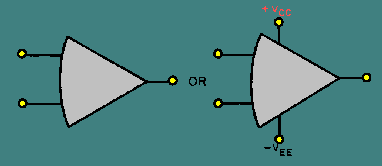
A17.
A18. Differential amplifier. Voltage amplifier. Output amplifier.
A19. The use of degenerative (negative) feed-back.
A20. Both the input signal and the feedback signal.
A21. Inverting. Inverting.
A22. 0 volts.
A23. Virtual.
A24. -50 millivolts.
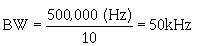
A25. 50 kilohertz (Gain = 10; Gain- Bandwidth Product = 500,000;
A26. 60 millivolts.
A27. 1 megahertz. Open-loop Gain-Bandwidth Product = Closed-loop Gain-Bandwidth
Prod.Open-loop Gain-Bandwidth Product = 200,000 X 30 (Hz)Open-loop Gain Bandwidth Product
= 600,000Closed-loop Gain Bandwidth Product = 6 X Bandwidth6,000,000 = 6 X
Bandwidth1,000,000 (Hz) = Bandwidth
A28. The adder simply adds the input signals together while the summing amplifier
multiplies the sum of the input signals by the gain of circuit.
A29. Yes, a summing amplifier can have as many inputs as desired.
A30. A summing amplifier that applies a factor to each input signal beforeadding the
results.
A31. A scaling amplifier.
A32.
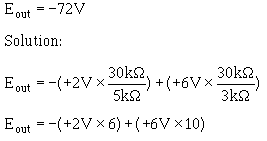
A33. 0 volts. (The two inputs to the operational
amplifier are both at 0 volts.)
A34. The difference amplifier multiplies the difference between the two inputs by the gain
of the circuit while the subtractor merely subtracts one input signal from the other.
A35. No.
A36. A difference amplifier.
A37.
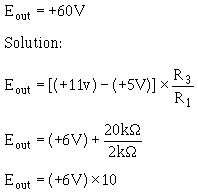
A38. 0 volts. (The two inputs to the operational
amplifier are both at the same potential.)
A39. An audio (or low) frequency power amplifier.
A40. A change in inductance in a series LR circuit causes a change in true power.
A41. It decreases.
A42. (a) Inductance increases; (b) true power decreases.
A43. Permeability decreases.
A44. A change in inductance.
A45.

A46. The knee of the curve.
A47. Use two load windings whose flux effects cancel in the core of the reactor or use two
load windings on two toroidal cores so that load flux always aids control flux in one core
and opposes control flux in the other core.
A48. The rectifier eliminates hysteresis loss.
A49. A bias winding and associated circuitry.
A50. Servosystems, temperature recorders, or power supplies.
|