Custom Search
|
|
  |
|
|
INTRODUCTION TO SATELLITE COMMUNICATIONS LEARNING OBJECTIVES Upon completion of this chapter you will be able to:
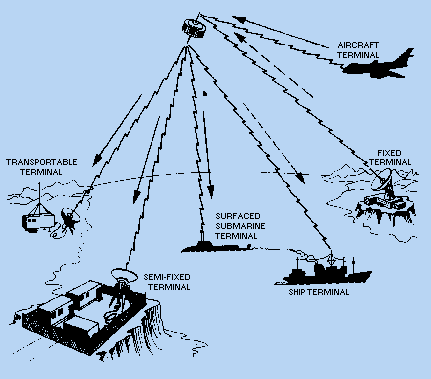
HISTORY OF SATELLITE COMMUNICATIONS The first artificial satellite was placed in orbit by the Russians in 1957. That satellite, called Sputnik, signaled the beginning of an era. The United States, who was behind the Russians, made an all-out effort to catch up, and launched Score in 1958. That was the first satellite with the primary purpose of communications. The first regular satellite communications service was used by the Navy in 1960. The moon was used to bounce teletypewriter signals between Hawaii and Washington, D.C. During the early 1960s, the Navy used the moon as a medium for passing messages between ships at sea and shore stations. This method of communications proved reliable when other methods failed. Military satellite communications technology was at a low level until 1965. At that time high quality voice transmissions were conducted between a satellite and two earth stations. That was the stepping stone to the Initial Defense Communications Satellite Program (IDCSP), which will be covered later in this chapter. Experience with satellite communications has demonstrated that satellite systems can satisfy many military requirements. They are reliable, survivable, secure, and a cost effective method of telecommunications. You can easily see that satellites are the ideal, if not often the only, solution to problems of communicating with highly mobile forces. Satellites, if properly used, provide much needed options to large, fixed-ground installations. For the past fifty years, the Navy has used high-frequency (hf) transmissions as the principal method of sending messages. In the 1970s, the hf spectrum was overcrowded and "free" frequencies were at a premium. Hf jamming and electronic countermeasures (ECM) techniques became highly sophisticated during that period. As a result the need for new and advanced long-range transmission methods became apparent. Communications via satellite is a natural outgrowth of modern technology and of the continuing demand for greater capacity and higher quality in communications. In the past, the various military branches have had the resources to support their communications needs. Predicted usage indicates that large-scale improvements will have to be made to satisfy future needs of the Department of Defense. These needs will require greater capacity for long-haul communications to previously inaccessible areas. Satellite communications has the most promise for satisfying these future requirements. DEFENSE COMMUNICATIONS SATELLITE PROGRAM (DCSP) The Defense Communications Satellite Program (DCSP) was initiated by the Secretary of Defense in 1962. Phase I of the program was given the title Initial Defense Communications Satellite Program (IDCSP). The first satellite launch occurred in June 1966 when seven experimental satellites were placed into orbit. The final launch of this program consisted of eight satellites and occurred in June 1968. DEFENSE SATELLITE COMMUNICATIONS SYSTEM (DSCS) PHASE II The Phase II Defense Satellite Communications System (DSCP Phase II) has changed from an all-analog communications system to an all-digital communications system. The performance capability provided by the Phase II DSCS is limited by equipment availability. Extensive digital traffic capability has become common. You can credit this to the availability of digital modems (modulator/demodulator) and broadband equipment. Overall performance of the Phase II DSCS is a great improvement over the capabilities provided by Phase I DSCS. The Phase II satellites provide a great increase in effective radiated power and rf bandwidths. You will find these satellite configurations use wide coverage and narrow beam antennas. They provide an extensive range of communications services and capabilities. (This will be further discussed later, in this chapter.) FUNDAMENTAL SATELLITE COMMUNICATIONS SYSTEM A satellite communications system uses satellites to relay radio transmissions between earth terminals. The two types of communications satellites you will study are ACTIVE and PASSIVE. A passive satellite only reflects received radio signals back to earth. An active satellite acts as a REPEATER; it amplifies signals received and then retransmits them back to earth. This increases signal strength at the receiving terminal to a higher level than would be available from a passive satellite. A typical operational link involves an active satellite and two or more earth terminals. One station transmits to the satellite on a frequency called the UP-LINK frequency. The satellite then amplifies the signal, converts it to the DOWN-LINK frequency, and transmits it back to earth. The signal is next picked up by the receiving terminal. Figure 4-1 shows a satellite handling several combinations of links simultaneously. Figure 4-1. - Satellite communications system.
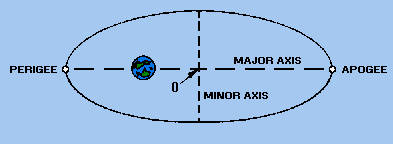
DESCRIPTION OF COMMUNICATIONS SATELLITE SYSTEM The basic design of a satellite communications system depends to a great degree upon the characteristics of the orbit of the satellite. In general terms, an orbit is either elliptical or circular in shape. A special type of orbit is a SYNCHRONOUS ORBIT. In this type you will find the period (time required for one revolution) of the orbit the same as that of the earth. An orbit that is not synchronous is called ASYNCHRONOUS. A period of orbit that approaches that of the earth is called NEAR SYNCHRONOUS (subsynchronous). Orbits are discussed in more detail later in this chapter. In addition to the fundamental components shown in figure 4-1, the design of the overall system determines the complexity of the various components and the manner in which the system operates. Current satellites are capable of handling many teletypewriter (tty) and voice circuits at the same time. Orbit Descriptions Orbits generally are described according to the physical shape of the orbit and the angle of inclination of the plane of the orbit. These terms aye discussed in the following paragraphs: PHYSICAL SHAPE. - All satellites orbit the earth in elliptical orbits. (A circle is a special case of an ellipse.) The shape of the orbit is determined by the initial launch parameters and the later deployment techniques used. PERIGEE and APOGEE are two, of the three parameters used to describe orbital data of a satellite. These are shown on figure 4-2. Perigee is the point in the orbit nearest to the center of the earth. Apogee is the point in the orbit the greatest distance from the center of the earth. Both distances are expressed in nautical miles. Figure 4-2. - Elliptical satellite orbit.
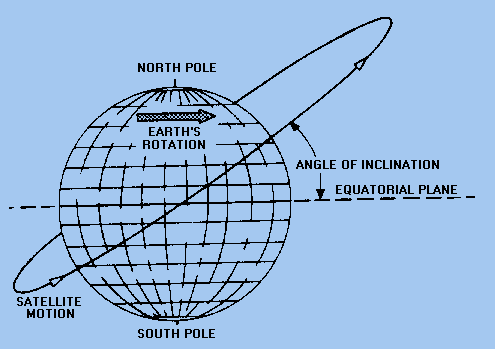
ANGLE OF INCLINATION. - The ANGLE OF INCLINATION (angle between the equatorial plane of the earth and the orbital plane of the satellite) is the third parameter used to describe the orbit data of a satellite. Figure 4-3 depicts the angle of inclination between the equatorial plane and the orbital plane. Most satellites orbit the earth in orbital planes that do not coincide with the equatorial plane of the earth. A satellite orbiting in any plane not identical with the equatorial plane is in an INCLINED ORBIT. Figure 4-3. - Inclined satellite orbit.
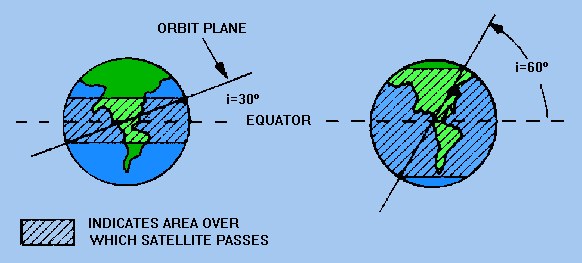
The inclination of the orbit determines the area covered by the path of the satellite. As shown in figure 4-4, the greater the inclination, the greater the amount of surface area covered by the satellite. Figure 4-4. - Effect of orbit plane inclination on satellite coverage.
SPECIAL TYPES OF INCLINED ORBITS. - A satellite orbiting in a plane that coincides with the equatorial plane of the earth is in an EQUATORIAL ORBIT. A satellite orbiting in an inclined orbit with an angle of inclination of 90 degrees or near 90 degrees is in a POLAR ORBIT. SPECIAL TYPES OF CIRCULAR ORBITS. - We stated previously that a circular orbit is a special type of elliptical orbit. You should realize a circular orbit is one in which the major and minor axis distances are equal or approximately equal. Mean height above earth, instead of perigee and apogee, is used in describing a circular orbit. While we are discussing circular orbits, you should look at some of the terms mentioned earlier in this chapter. A satellite in a circular orbit at a height of approximately 19,300 nautical miles above the earth is in a synchronous orbit. At this altitude the period of rotation of the satellite is 24 hours, the same as the rotation period of the earth. In other words, the orbit of the satellite is in sync with the rotational motion of the earth. Although inclined and polar synchronous orbits are possible, the term synchronous usually refers to a synchronous equatorial orbit. In this type of orbit, satellites appear to hover motionlessly in the sky. Figure 4-5 shows how one of these satellites can provide coverage to almost half the surface of the earth. Figure 4-5. - Illumination from a synchronous satellite.
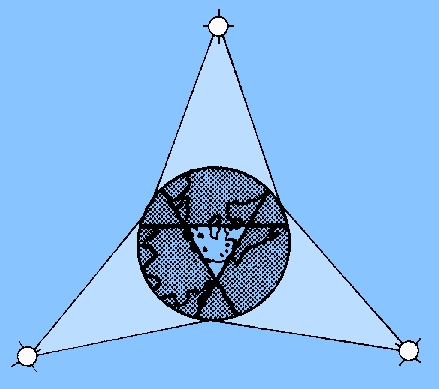
Three of these satellites can provide coverage over most of the earth (except for the extreme north and south polar regions). A polar projection of the global coverage of a three-satellite system is shown in figure 4-6. Figure 4-6. - Worldwide synchronous satellite system viewed from above the North Pole.
A satellite in a circular orbit at other than 19,300 nautical miles above the earth is in a near-synchronous orbit. If the orbit is lower than 19,300 nautical miles, the period of orbit of the satellite is less than the period of orbit of the earth. The satellite then appears to be moving slowly around the earth from west to east. (This type of orbit is also called subsynchronous.) If the orbit is higher than 19,300 nautical miles, the period of orbit of the satellite is greater than the period of orbit of the earth. The satellite then appears to be moving slowly around the earth from east to west. Although inclined and polar near-synchronous orbits are possible, near synchronous implies an equatorial orbit. A satellite in a circular orbit from approximately 2,000 miles to 12,000 miles above the earth is considered to be in a MEDIUM ALTITUDE ORBIT. The period of a medium altitude satellite is considerably less than that of the earth. When you look at this altitude satellite, it appears to move rather quickly across the sky from west to east. Q.1 What are the two types of communications satellites? |
 |
|
|
Integrated Publishing, Inc. - A (SDVOSB) Service Disabled Veteran Owned Small Business
|