Custom Search
|
|
  |
|
|
SUMMARY This chapter has presented information on the characteristics of microwave antennas. The information that follows summarizes the important points of this chapter. The ANTENNA CHARACTERISTICS of microwave and low-frequency antennas are essentially the same. The efficiency of an antenna is expressed as a POWER GAIN or POWER RATIO as compared to a standard reference antenna. The STANDING WAVE RATIO (swr) is a measurement of the impedance mismatch between a transmission line and its load and is an indicator of overall system efficiency. DIRECTIVITY refers to the direction in which an antenna radiates and the narrowness of the radiated beam in DIRECTIONAL ANTENNAS. OMNIDIRECTIONAL ANTENNAS radiate and receive in all directions at once. RECIPROCITY is the ability of an antenna to both transmit and receive electromagnetic energy. REFLECTOR ANTENNAS are antennas that use a reflector to focus electromagnetic energy into a beam that is directional in either the vertical plane, the horizontal plane, or both planes at once. The basic PARABOLIC REFLECTOR shown in the illustration, or one of its variations, is most often used.
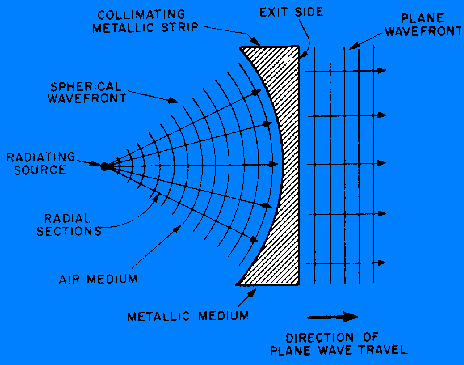
LENS ANTENNAS use a COLLIMATING LENS to force the spherical components of a wavefront into parallel (focused) paths by delaying or accelerating portions of the wavefronts, as shown in the illustration.
An ANTENNA ARRAY is a set of antenna elements and may be one of two basic types, the DRIVEN ARRAY or the PARASITIC ARRAY. FREQUENCY-SENSITIVE ANTENNAS use frequency-sensitive slots as radiation sources to achieve directivity. The angle at which the radiated beam leaves the antenna is determined by the frequency of the radiated energy. Currently the most common frequency-sensitive antennas use this feature to achieve elevation coverage while azimuth coverage is achieved by rotating the antennas. New systems will use stationary frequency-sensitive antennas to achieve both azimuth and elevation coverage. |
|
|
|
Integrated Publishing, Inc. - A (SDVOSB) Service Disabled Veteran Owned Small Business
|