Custom Search
|
|
  |
|
|
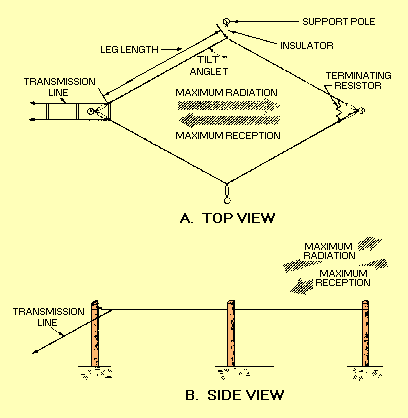
RHOMBIC ANTENNA The highest development of the long-wire antenna is the RHOMBIC ANTENNA (see figure 4-37). It consists of four conductors joined to form a rhombus, or diamond shape. The antenna is placed end to end and terminated by a noninductive resistor to produce a uni-directional pattern. A rhombic antenna can be made of two obtuse-angle V antennas that are placed side by side, erected in a horizontal plane, and terminated so the antenna is nonresonant and unidirectional. Figure 4-37. - Basic rhombic antenna.
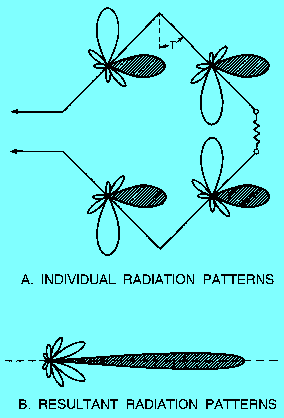
The rhombic antenna is WIDELY used for long-distance, high-frequency transmission and reception. It is one of the most popular fixed-station antennas because it is very useful in point-to-point communications. Advantages The rhombic antenna is useful over a wide frequency range. Although some changes in gain, directivity, and characteristic impedance do occur with a change in operating frequency, these changes are small enough to be neglected. The rhombic antenna is much easier to construct and maintain than other antennas of comparable gain and directivity. Only four supporting poles of common heights from 15 to 20 meters are needed for the antenna. The rhombic antenna also has the advantage of being noncritical as far as operation and adjustment are concerned. This is because of the broad frequency characteristics of the antenna. Still another advantage is that the voltages present on the antenna are much lower than those produced by the same input power on a resonant antenna. This is particularly important when high transmitter powers are used or when high-altitude operation is required. Disadvantages The rhombic antenna is not without its disadvantages. The principal one is that a fairly large antenna site is required for its erection. Each leg is made at least 1 or 2 wavelengths long at the lowest operating frequency. When increased gain and directivity are required, legs of from 8 to 12 wavelengths are used. These requirements mean that high-frequency rhombic antennas have wires of several hundred feet in length. Therefore, they are used only when a large plot of land is available. Another disadvantage is that the horizontal and vertical patterns depend on each other. If a rhombic antenna is made to have a narrow horizontal beam, the beam is also lower in the vertical direction. Therefore, obtaining high vertical-angle radiation is impossible except with a very broad horizontal pattern and low gain. Rhombic antennas are used, however, for long-distance skywave coverage at the high frequencies. Under these conditions low vertical angles of radiation (less than 20 degrees) are desirable. With the rhombic antenna, a considerable amount of the input power is dissipated uselessly in the terminating resistor. However, this resistor is necessary to make the antenna unidirectional. The great gain of the antenna more than makes up for this loss. Figure 4-38 shows the individual radiation patterns produced by the four legs of the rhombic antenna and the resultant radiation pattern. The principle of operation is the same as for the V and the half-rhombic antennas. Figure 4-38. - Formation of a rhombic antenna beam.
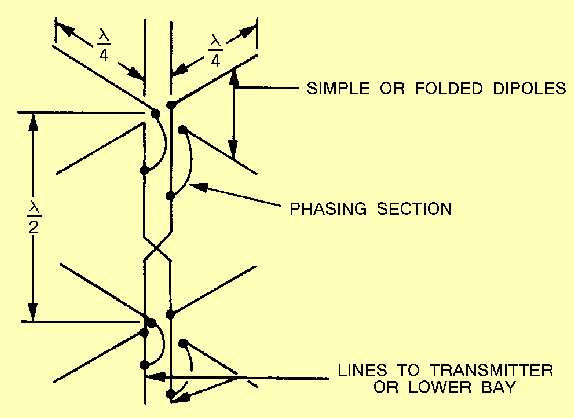
Terminating Resistor The terminating resistor plays an important part in the operation of the rhombic antenna. Upon it depend the unidirectivity of the antenna and the lack of resonance effects. An antenna should be properly terminated so it will have a constant impedance at its input. Terminating the antenna properly will also allow it to be operated over a wide frequency range without the necessity for changing the coupling adjustments at the transmitter. Discrimination against signals coming from the rear is of great importance for reception. The reduction of back radiation is perhaps of lesser importance for transmission. When an antenna is terminated with resistance, the energy that would be radiated backward is absorbed in the resistor. Q.47 What is the main disadvantage of the rhombic antenna? TURNSTILE ANTENNA The TURNSTILE ANTENNA is one of the many types that has been developed primarily for omnidirectional vhf communications. The basic turnstile consists of two horizontal half-wave antennas mounted at right angles to each other in the same horizontal plane. When these two antennas are excited with equal currents 90 degrees out of phase, the typical figure-eight patterns of the two antennas merge to produce the nearly circular pattern shown in figure 4-39, view A. Pairs of such antennas are frequently stacked, as shown in figure 4-40. Each pair is called a BAY. In figure 4-40 two bays are used and are spaced 1/2 wavelength apart, and the corresponding elements are excited in phase. These conditions cause a part of the vertical radiation from each bay to cancel that of the other bay. This results in a decrease in energy radiated at high vertical angles and increases the energy radiated in the horizontal plane. Stacking a number of bays can alter the vertical radiation pattern, causing a substantial gain in a horizontal direction without altering the overall horizontal directivity pattern. Figure 4-39, view B, compares the circular vertical radiation pattern of a single-bay turnstile with the sharp pattern of a four-bay turnstile array. A three-dimensional radiation pattern of a four-bay turnstile antenna is shown in figure 4-39, view C. Figure 4-39. - Turnstile antenna radiation pattern.
Figure 4-40. - Stacked turnstile antennas.
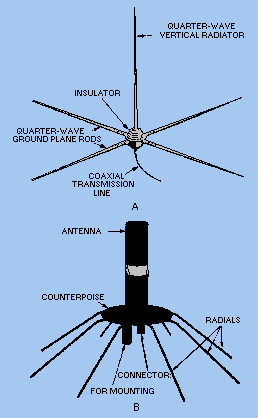
GROUND-PLANE ANTENNA A vertical quarter-wave antenna several wavelengths above ground produces a high angle of radiation that is very undesirable at vhf and uhf frequencies. The most common means of producing a low angle of radiation from such an antenna is to work the radiator against a simulated ground called a GROUND PLANE. A simulated ground may be made from a large metal sheet or several wires or rods radiating from the base of the radiator. An antenna so constructed is known as a GROUND-PLANE ANTENNA. Two ground-plane antennas are shown in figure 4-41, views A and B. Figure 4-41. - Ground-plane antennas.
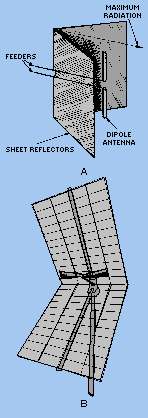
CORNER REFLECTOR When a unidirectional radiation pattern is desired, it can be obtained by the use of a corner reflector with a half-wave dipole. A CORNER-REFLECTOR ANTENNA is a half-wave radiator with a reflector. The reflector consists of two flat metal surfaces meeting at an angle immediately behind the radiator. In other words, the radiator is set in the plane of a line bisecting the corner angle formed by the reflector sheets. The construction of a corner reflector is shown in figure 4-42. Corner-reflector antennas are mounted with the radiator and the reflector in the horizontal position when horizontal polarization is desired. In such cases the radiation pattern is very narrow in the vertical plane, with maximum signal being radiated in line with the bisector of the corner angle. The directivity in the horizontal plane is approximately the same as for any half-wave radiator having a single-rod type reflector behind it. If the antenna is mounted with the radiator and the corner reflector in the vertical position, as shown in view A, maximum radiation is produced in a very narrow horizontal beam. Radiation in a vertical plane will be the same as for a similar radiator with a single-rod type reflector behind it. Figure 4-42. - Corner-reflector antennas.
Q48. What is the primary reason for the development of the turnstile antenna? |
 |
|
|
Integrated Publishing, Inc. - A (SDVOSB) Service Disabled Veteran Owned Small Business
|