Custom Search
|
|
  |
|
|
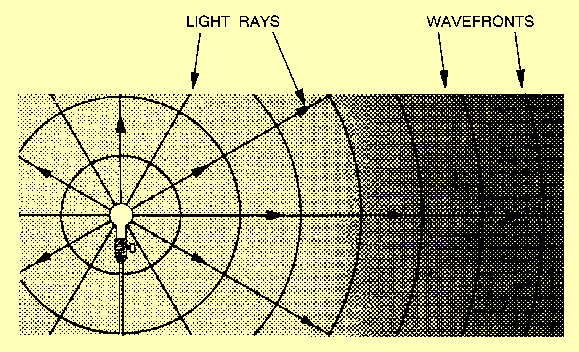
LIGHT WAVES Technicians maintain equipment that use frequencies from one end of the electromagnetic spectrum to the other - from low-frequency radio waves to high-frequency X-rays and cosmic rays. Visible light is a small but very important part of this electromagnetic spectrum. Most of the important terms that pertain to the behavior of waves, such as reflection, refraction, diffraction, etc., were discussed earlier in this chapter. We will now discuss how these terms are used in understanding light and light waves. The relationship between light and light waves (rays) is the same as sound and sound waves. Light is a form of energy. It can be produced by various means (mechanical, electrical, chemical, etc.). We can see objects because the light rays they give off or reflect reach our eyes. If the object is the source of light energy, it is called luminous. If the object is not the source of light but reflects light, it is called an illuminated body. The exact nature of light is not fully understood, although scientists have been studying the subject for many centuries. Some experiments seem to show that light is composed of tiny particles, and some suggest that it is made up of waves. One theory after another attracted the approval and acceptance of physicists. Today, some scientific phenomena can be explained only by the wave theory and others only by the particle theory. Physicists, constantly searching for some new discovery that would bring these two theories into agreement, gradually have come to accept a theory that combines the principles of the two theories. According to the view now generally accepted, light is a form of electromagnetic radiation; that is, light and similar forms of radiation are made up of moving electric and magnetic fields. These two fields will be explained thoroughly later in this chapter. ELECTROMAGNETIC THEORY OF LIGHT James Clark Maxwell, a brilliant Scottish scientist Of the middle l9th century, showed, by constructing an oscillating electrical circuit, that electromagnetic waves could move through empty space. Light eventually was proved to be electromagnetic. Current light theory says that light is made up of very small packets of electromagnetic energy called PHOTONS (the smallest unit of radiant energy). These photons move at a constant speed in the medium through which they travel. Photons move at a faster speed through a vacuum than they do in the atmosphere, and at a slower speed. through water than air. The electromagnetic energy of light is a form of electromagnetic radiation. Light and similar forms of radiation are made up of moving electric and magnetic forces and move as waves. Electromagnetic waves move in a manner similar to the waves produced by the pebble dropped in the pool of water discussed earlier in this chapter. The transverse waves of light from a light source spread out in expanding circles much like the waves in the pool. However, the waves in the pool are very slow and clumsy in comparison with light, which travels approximately 186,000 miles per second. Light radiates from its source in all directions until absorbed or diverted by some substance (fig. 1-17). The lines drawn from the light source (a light bulb in this instance) to any point on one of these waves indicate the direction in which the waves are moving. These lines, called radii of the spheres, are formed by the waves and are called LIGHT RAYS. Figure 1-17. - Waves and radii from a nearby light source.
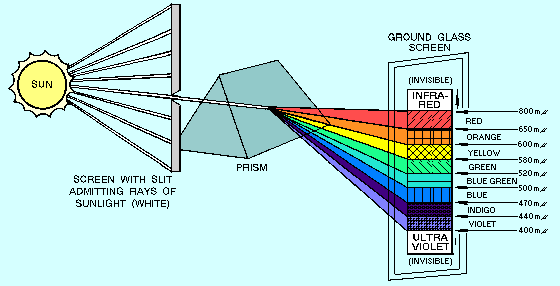
Although single rays of light do not exist, light "rays" as used in illustrations are a convenient method used to show the direction in which light is traveling at any point. A large volume of light is called a beam; a narrow beam is called a pencil; and the smallest portion of a pencil is called a light ray. A ray of light, can be illustrated as a straight line. This straight line drawn from a light source will represent an infinite number of rays radiating in all directions from the source. Q.31 What are three means of producing light? FREQUENCIES AND WAVELENGTHS Compared to sound waves, the frequency of light waves is very high and the wavelength is very short. To measure these wavelengths more conveniently, a special unit of measure called an ANGSTROM UNIT, or more usually, an ANGSTROM was devised. Another common unit used to measure these waves is the millimicron (mm), which is one millionth of a millimeter. One mF equals ten angstroms. One angstrom equals 10-10m. Q.33 What unit is used to measure the different wavelengths of light? FREQUENCIES AND COLOR For our discussion of light wave waves, we will use the millimicron measurement. The wavelength of a light determines the color of the light. Figure 1-18 indicates that light with a wavelength of 700 millimicrons is red, and that light with a wavelength of 500 millimicrons is blue-green. This illustration shows approximate wavelengths of the different colors in the visible spectrum. In actual fact, the color of light depends on its frequency, not its wavelength. However, light is measured in wavelengths. Figure 1-18. - Use of a prism to split white light into different colors.
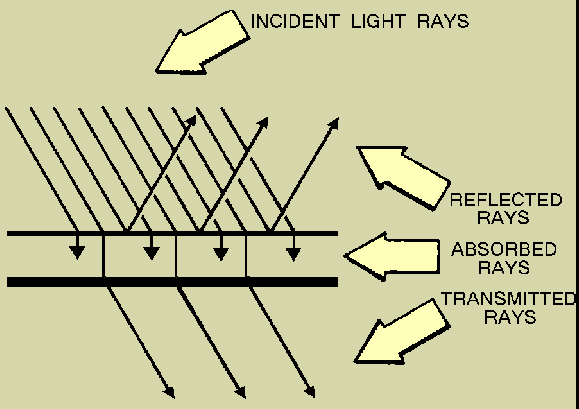
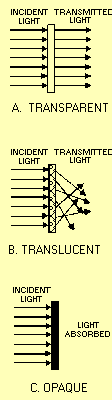
When the wavelength of 700 millimicrons is measured in a medium such as air, it produces the color red, but the same wave measured in a different medium will have a different wavelength. When red light which has been traveling in air enters glass, it loses speed. Its wavelength becomes shorter or compressed, but it continues to be red. This illustrates that the color of light depends on frequency and not on wavelength. The color scale in figure 1-18 is based on the wavelengths in air. When a beam of white light (sunlight) is passed through a PRISM, as shown in figure 1-18, it is refracted and dispersed (the phenomenon is known as DISPERSION) into its component wavelengths. Each of these wavelengths causes a different reaction of the eye, which sees the various colors that compose the visible spectrum. The visible spectrum is recorded as a mixture of red, orange, yellow, green, blue, indigo, and violet. White light results when the PRIMARIES (red, green, and blue) are mixed together in overlapping beams of light. (NOTE: These are not the primaries used in mixing pigments, such as in paint.) Furthermore, the COMPLEMENTARY or SECONDARY colors (magenta, yellow, and cyan) may be shown with equal ease by mixing any two of the primary colors in overlapping beams of light. Thus, red and green light mixed in equal intensities will make yellow light; green and blue will produce cyan (blue-green light); and blue and red correctly mixed will produce magenta (a purplish red light). LIGHT AND COLOR All objects absorb some of the light that falls on them. An object appears to be a certain color because it absorbs all of the light waves except those whose frequency corresponds to that particular color. Those waves are reflected from the surface, strike your eye, and cause you to see the particular color. The color of an object therefore depends on the frequency of the electromagnetic wave reflected. LUMINOUS BODIES Certain bodies, such as the sun, a gas flame, and an electric light filament, are visible because they are light sources. They are called SELF-LUMINOUS bodies. Objects other than self-luminous bodies become visible only when they are in the presence of light from luminous bodies. Most NONLUMINOUS bodies are visible because they diffuse or reflect the light that falls on them. A good example of a nonluminous diffusing body is the moon, which shines only because the sunlight falling onto its surface is diffused. Black objects do not diffuse or reflect light. They are visible only when outlined against a background of light from a luminous or diffusing body. When light waves, which travel in straight lines, encounter any substance, they are either transmitted, refracted, reflected, or absorbed. This is illustrated in figure 1-19. When light strikes a substance, some absorption and some reflection always take place. No substance completely transmits, reflects, or absorbs all of the light rays that reach its surface. Substances that transmit almost all the light waves that fall upon them are said to be TRANSPARENT. A transparent substance is one through which you can see clearly. Clear glass is transparent because it transmits light rays without diffusing them (view A of figure 1-20). There is no known perfectly transparent substance, but many substances are nearly so. Substances through which some light rays can pass but through which objects cannot be seen clearly because the rays are diffused are called TRANSLUCENT (view B of figure 1-20). The frosted glass of a light bulb and a piece of oiled paper are examples of translucent materials. Substances that do not transmit any light rays are called OPAQUE (view C of figure 1-20). Opaque substances can either reflect or absorb all of the light rays that fall upon them. Figure 1-19. - Light waves reflected, absorbed, and transmitted.
Figure 1-20. - Transparent, translucent, and opaque substances.
Q.34 What are the three primary colors of light? |
 |
|
|
Integrated Publishing, Inc. - A (SDVOSB) Service Disabled Veteran Owned Small Business
|