Custom Search
|
|
  |
|
|
INDEFINITE INTEGRALS When
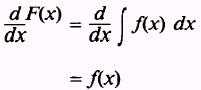
we were finding the derivative of a function, we wrote
where
the derivative of F(x) is f(x). Our problem is to find F(x) when we are given
f(x). We
know that the symbol
and
when the derivative of each side is taken, d annulling
or
where
From
this, we find that
so
that,
Also
we find that
so that,
Again, we find that
so that,
This is to say that
and
where C is any constant of integration. A number that is independent of the variable of
integration is called a constant of integration. Since C may
have infinitely many values, then a differential expression may have infinitely
many integrals differing only by the constant. This is to say that two
integrals of the same function may differ by the constant of integration. We
assume the differential expression has at least one integral. Because the
integral contains C and C is indefinite, we call
an indefinite integral of f(x) dx.
In the general form we say
With regard to the constant of integration, a theorem and
its converse are stated as follows: Theorem 1. If two functions differ by a constant, they have the same
derivative. Theorem 2. If two functions have the same derivative, their
difference is a constant. |
|












 ...
... 



 ,
,