Custom Search
|
|
  |
|
|
DERIVATIVES OF VARIABLES In this section of variables, we will extend the theorems
of limits covered previously. Recall that a derivative is actually a limit. The
proof of the theorems presented here involve the delta process. POWER FORM Theorem 2. The derivative of the function
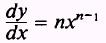
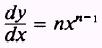
is
given by
if
n is any real number. PROOF: By definition
The expression
Substituting in the expression for the derivative, we have
Simplifying, this becomes
Letting
Thus, the proof is complete. EXAMPLE: Find the derivative of
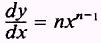
SOLUTION: Apply Theorem 2, such that,
Therefore, n=5 and n-1=4 so that given
and substituting values for n, find
that
EXAMPLE: Find the derivative of
SOLUTION Apply Theorem 2, such that,
Therefore,
and n-1=0 so that
The previous example is a special case of the power form
and indicates that the derivative of a function with respect to itself is 1. EXAMPLE: Find the derivative of
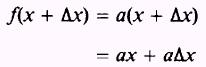
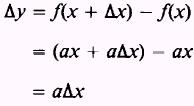
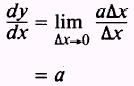
where a is a constant. SOLUTION
and
so that
Therefore,
Table
5-1.-Derivatives of Functions
The previous example is a continuation of the derivative
of a function with respect to itself and indicates that the derivative of a
function with respect to itself, times a constant, is that constant. EXAMPLE. Find the derivative of
SOLUTION:
A study of the functions and their derivatives in table 5-1 should
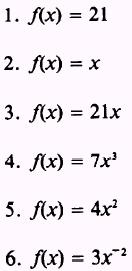
further the understanding of this section. PRACTICE PROBLEMS: Find the derivatives of the following:
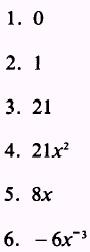
ANSWERS:
|
|












 may be expanded by the binomial theorem into


 x
approach zero, we have
x
approach zero, we have