Custom Search
|
|
  |
|
|
PRACTICE
PROBLEMS: Give
the equation; the length of a; and the length of the focal chord for the
parabola, which is the locus of all points equidistant from the point and the
line, given in the following problems:
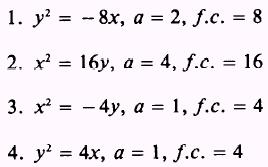
ANSWERS:
Up
to now, all of the parabolas we have dealt with have had a vertex at the origin
and a corresponding equation in one of the four following forms: 1.
y2 = 4ax 2.
y2 = - 4ax 3. x2 = 4ay 4. x2 = - 4ay We
will now present four more forms of the equation of a parabola. Each one is a
standardized parabola with its vertex at point V(h,k). When the vertex is moved
from the origin to the point V(h,k), the x and y terms of the equation are
replaced by (x - h) and (y - k). Then
the standard equation for the parabola that opens to the right (fig. 2-9, view A) is
The
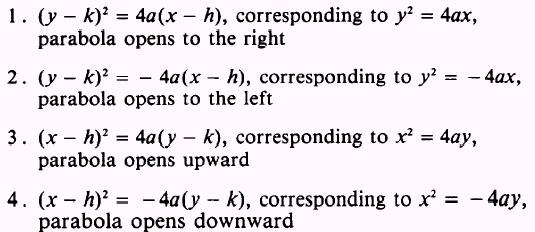
four standard forms of the equations for parabolas with vertices at the point V(h,k) are as follows:
The
method for reducing an equation to one of these standard forms is similar to
the method used for reducing the equation of a circle. EXAMPLE:
Reduce the equation
to
standard form. SOLUTION:
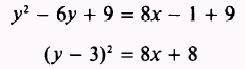
Rearrange the equation so that the second-degree term and any first-degree
terms of the same unknown are on the left side. Then group the unknown term
appearing only in the first degree and all constants on the right:
To get the equation in the form
factor an 8 out of the right side. Thus,
is the equation of the parabola with its vertex at (-1,3). PRACTICE PROBLEMS: Reduce the equations given in the following problems to
standard form:
ANSWERS:
|
|