| Tweet |

Custom Search
|
|
 
|
||
|
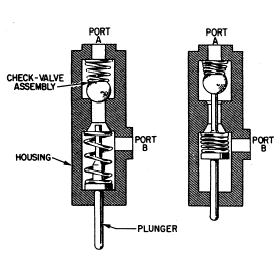
Mechanically Operated Sequence Valve The mechanically operated sequence valve (fig. 6-17) is operated by a plunger that extends through the body of the valve. The valve is mounted so that the plunger will be operated by the primary unit.A check valve, either a ball or a poppet, is installed between the fluid ports in the body. It can be unseated by either the plunger or fluid pressure.Port A (fig. 6-17) and the actuator of the primary unit are connected by a common line. Port B is connected by a line to the actuator of the secondary unit. When fluid under pressure flows to the primary unit, it also flows into the sequence valve through port A to the seated check valve in the sequence valve. In order to operate the secondary unit, the fluid must flow through the sequence valve. The valve is located so that the primary unit depresses the plunger as it completes its operation. The plunger unseats the check valve and allows the fluid to flow
Figure 6-17.Mechanically operated sequence valve. through the valve, out port B, and to the secondary unit.This type of sequence valve permits flow in the opposite direction. Fluid enters port B and flows to the check valve. Although this is return flow from the actuating unit, the fluid overcomes spring tension, unseats the check valve, and flows out through port A.PRESSURE-REDUCING VALVES Pressure-reducing valves provide a steady pressure into a system that operates at a lower pressure than the supply system. A reducing valve can normally be set for any desired downstream pressure within the design limits of the valve. Once the valve is set, the reduced pressure will be maintained regardless of changes in supply pressure (as long as the supply pressure is at least as high as the reduced pressure desired) and regardless of the system load, providing the load does not exceed the design capacity of the reducer.
Figure 6-18.Spring-loaded pressure-reducing valve. There are various designs and types of pressure-reducing valves. The spring-loaded reducer and the pilot-controlled valve are discussed in this text.Spring-Loaded Reducer The spring-loaded pressure-reducing valve (fig. 6-18) is commonly used in pneumatic systems. It is often referred to as a pressure regulator.The valve simply uses spring pressure against a diaphragm to open the valve. On the bottom of the diaphragm, the outlet pressure (the pressure in the reduced-pressure system) of the valve forces the diaphragm upward to shut the valve. When the outlet pressure drops below the set point of the valve, the spring pressure overcomes the outlet pressure and forces the valve stem downward, opening the valve. As the outlet pressure increases, approaching the desired value, the pressure under the diaphragm begins to overcome spring pressure, forcing the valve stem upwards, shutting the valve. You can adjust the downstream pressure by turning the adjusting screw, which varies the spring pressure against the diaphragm. This particular spring-loaded valve will fail in the open position if a diaphragm rupture occurs.Pilot-Controlled Pressure-Reducing Valve Figure 6-19 illustrates the operation of a pilot-controlled pressure-reducing valve. This valve consists of an adjustable pilot valve, which controls the operating pressure of the valve, and a spool valve, which reacts to the action of the pilot valve.The pilot valve consists of a poppet (1), a spring (2), and an adjusting screw (3). The valve
Figure 6-19.Pilot-controlled pressure-reducing valve. spool assembly consists of a valve spool (10) and a spring (4). Fluid under main pressure enters the inlet port (11) and under all conditions is free to flow through the valve and the outlet port (5). (Either port 5 or port 11 maybe used as the high-pressure port.)Figure 6-19, view A, shows the valve in the open position. In this position, the pressure in the reduced-pressure outlet port (6) has not reached the preset operating pressure of the valve. The fluid also flows through passage 8, through smaller passage 9 in the center of the valve spool, and into chamber 12. The fluid pressure at outlet port 6 is therefore distributed to both ends of the spool. When these pressures are equal the spool is hydraulically balanced. Spring 4 is a low-tension spring and applies only a slight downward force on the spool. Its main purpose is to position the spool and to maintain opening 7 at its maximum size. As the pressure increases in outlet port 6 (fig. 16, view B), this pressure is transmitted through passages 8 and 9 to chamber 12. This pressure also acts on the pilot valve poppet (1). When this pressure increases above the preset operating pressure of the valve, it overcomes the force of pilot valve spring 2 and unseats the poppet. This allows fluid to flow through the drain port (15). Because the small passage (9) restricts flow into chamber 12, the fluid pressure in the chamber drops. This causes a momentary difference in pressure across the valve spool (10) which allows fluid pressure acting against the bottom area of the valve spool to overcome the downward force of spring 4. The spool is then forced upward until the pressures across its ends are equalized. As the spool moves upward, it restricts the flow through opening 7 and causes the pressure to decrease in the reduced pressure outlet port 6. If the pressure in the outlet port continues to increase to a value above the preset pressure, the pilot valve will open again and the cycle will repeat. This allows the spool valve to move up higher into chamber 12; thus further reducing the size of opening 7. These cycles repeat until the desired pressure is maintained in outlet 6. When the pressure in outlet 6 decreases to a value below the preset pressure, spring 4 forces the spool downward, allowing more fluid to flow through opening 7. COUNTERBALANCE VALVE The counterbalance valve is normally located in the line between a directional control valve and the outlet of a vertically mounted actuating cylinder which supports weight or must be held in position for a period of time. This valve serves as a hydraulic resistance to the actuating cylinder. For example, counterbalance valves are used in some hydraulically operated forklifts. The valve offers a resistance to the flow from the actuating cylinder when the fork is lowered. It also helps to support the fork in the UP position.Counterbalance valves are also used in air-launched weapons loaders. In this case the valve is located in the top of the lift cylinder. The valve requires a specific pressure to lower the load. If adequate pressure is not available, the load cannot be lowered. This prevents collapse of the load due to any malfunction of the hydraulic system. One type of counterbalance valve is illustrated in figure 6-20. The valve element is a balanced spool (4). The spool consists of two pistons permanently fixed on either end of a shaft. The inner surface areas of the pistons are equal; therefore, pressure acts equally on both areas regardless of the position of the valve and has no effect on the movement of the valvehence, the term balanced. The shaft area between the two pistons provides the area for the fluid to flow
Figure 6-20. Counterbalance valve. when the valve is open. A small piston (9) is attached to the bottom of the spool valve. When the valve is in the closed position, the top piston of the spool valve blocks the discharge port (8). With the valve in this position, fluid flowing from the actuating unit enters the inlet port (5). The fluid cannot flow through the valve because discharge port 8 is blocked. However, fluid will flow through the pilot passage (6) to the small pilot piston. As the pressure increases, it acts on the pilot piston until it overcomes the preset pressure of spring 3. This forces the valve spool (4) up and allows the fluid to flow around the shaft of the valve spool and out discharge port 8. Figure 6-20 shows the valve in this position. During reverse flow, the fluid enters port 8. The spring (3) forces valve spool 4 to the closed position. The fluid pressure overcomes the spring tension of the check valve (7). The check valve opens and allows free flow around the shaft of the valve spool and out through port 5. The operating pressure of the valve can be adjusted by turning the adjustment screw (1), which increases or decreases the tension of the spring. This adjustment depends on the weight that the valve must support.It is normal for a small amount of fluid to leak around the top piston of the spool valve and into the area around the spring. An accumulation would cause additional pressure on top of the spool valve. This would require additional pressure to open the valve. The drain (2) provides a passage for this fluid to flow to port 8. |
 |
|
|
||