| Tweet |

Custom Search
|
|
 
|
||
|
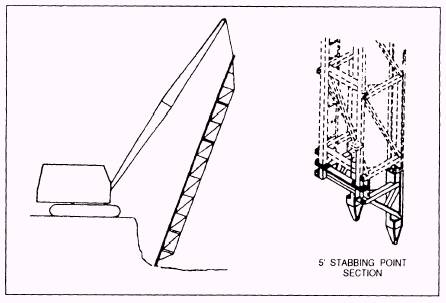
Swinging Leads Swinging leads are assembled facedown on the ground by bolting the 15-foot tapered section to the selected intermediate sections. A single crane line holds the pile-driving hammer that is slipped into and guided by the rails of the swinging leads. This lead is hung from the crane boom with a second single line from the crane. The lead is spotted on the ground at the pile location, normally with stabbing points attached to the bottom of the leads, and held plumb or at the desired batter with the second single crane line. Short swinging leads are often used to assist in driving
Figure 12-50.-Assembly of 10- and 20-foot lead sections. steel sheetpilings. Figure 12-51 shows the components of a swinging lead. The boom point sheaves are used to accommodate the hoist drum wire rope that supports the pile, pile-driving hammer, and leads; therefore, its use requires a three-drum crane. Under certain conditions a two-drum crane can be used The leads are raised to the vertical by a combination of booming, swinging, and/or traveling. ADVANTAGES.- Some advantages of using a swinging lead over other types of leads are as follows: 1. They are the lightest, simplest, and least expensive. 2. With stabbing points secured in the ground, these leads are free to rotate sufficiently to align the pile-driving hammer with the pile without precise alignment of the crane with the pile. 3. Because these leads are generally 15 to 20 feet shorter than the boom, the crane can reach out farther if the crane has sufficient capacity. 4. They can be used to drive piles in a hole, ditch, or over the edge of an excavation. 5. For long lead and boom requirements, the weight of the leads can be supported on the ground and the pile is lifted into place without excessively increasing the working load weight.
Figure 12-52.-Lead adapters connected to the boom tip. DISADVANTAGES.- Some disadvantages of using a swinging lead are as follows: 1. It requires a three-hoist drum crane (main line for the pile, secondary for the pile-driving hammer, and third for the leads) or two-hoist drum crane with the lead hung on the sling from the boom tip. 2. Because the leads are supported by the hoist wire rope, precise positioning of the leads with the top of the pile is difficult and slow. 3. If stabbing points are not secured to the ground, it is difficult to control the twisting of the leads.
Figure 12-51.-Swinging leads. NOTE: The tag line winder may be used to control the twisting of the leads. 4. Because these leads are not rigid, it is more difficult to position the crane to set up for pile-driving operations. |
||
|
||