| Tweet |

Custom Search
|
|
 
|
||
|
CYLINDER
HEAD STUDS AND GASKETS In many engines, the seal between the cylinder head and the block depends principally upon the integrity or smoothness of the metal surfaces, the gaskets, and the tightness of the fasteners. Studs Cylinder head studs are manufactured from round rod, generally of alloy steel. Threads are cut on both ends. The threads that screw into the block are generally made with finer threads than those on the nut end. This design allows for a tighter fit in the block, which keeps the stud from loosening when the stud nut is removed. Figure 3-18 illustrates a sequence for the tightening of fasteners for two types of cylinder heads. This sequence is not a hard and fast rule but can be followed in the absence of more specific information. Fasteners are generally tightened sufficiently to seat the cylinder head lightly (finger tight). At least two or three rounds of tightening should be made before all fasteners are brought up to the specified torque for the studs being used. When installing studs and nuts, you should carefully clean the threads of the studs and the nuts by wire-brushing and applying an approved solvent. Do not forget to inspect the blind holes and threads in the block. Cleaning will minimize
Figure 3-16.A General Motors EMD 645E5 cylinder bead.
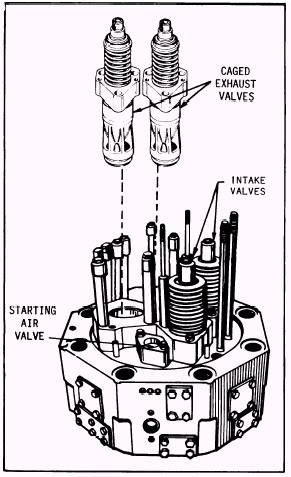
Figure 3-17.A Colt-Pielstick cylinder head with valves. wear and distortion of threads resulting from dirt. It will also increase the accuracy of the torque wrench readings. (It should be obvious that a higher torque wrench reading will be necessary to reach required tension when the threads are dirty than when they are clean.) Caution: Torque specifications are normally for clean, dry threaded fasteners. Torque specifications for lubricated fasteners are not the same as those for dry fasteners. All stud nuts should be tightened equally and according to specifications given in the manufacturers technical manual. Overtightening is as undesirable as undertightening. Sometimes studs that are relatively inaccessible are neglected during the periodic checks for tightness. Such an
Figure 3-18.Sequence for tightening cylinder head studs (fasteners).
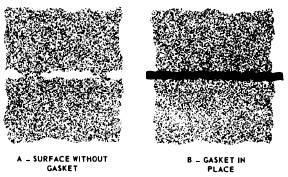
Figure 3-19.The principle of a gasket. oversight may result in studs coming loose and failing. Gaskets Even though gasket design is quite varied, all gaskets have compressibility as a common property. The principle by which this property is put to use in forming a seal between mating parts is illustrated in figure 3-19. The mating surfaces of a cylinder block and head may appear to be quite smooth; however, if these surfaces are highly magnified, existing irregularities can be seen. Irregularities such as those illustrated in view A of figure 3-19 are sufficient to allow leakage of the combustion gases, oil, or coolant unless some compressible material is used between the mating surfaces (view B). Materials used in the manufacture of gaskets vary as widely as does gasket design. Gaskets can be made from copper and other relatively soft metals, such as laminated steel sheets, fiber, cork, rubber, and synthetic rubber, and a combination of materials, such as copper and asbestos. Combinations of gaskets, seal rings, and grommets or similar devices (fig. 3-20) may be used in cylinder assemblies. These combinations serve to prevent the leakage of oil, water, and combustion gases between the cylinder block and the head. For additional information on gaskets, refer to Naval Ships Technical Manual, chapter 078. |
 
|
|
|
||