Custom Search
|
|
 
|
||
|
TECHNIQUES OF SKETCHING The sketch should conform to one of the standard types of projection discussed in this chapter. You must apply correct proportion whenever possible. When you use cross-section paper, its grid will provide a ready scale that will aid you in sketching proportionally. You do this by counting the squares within the object to be drawn. The size of your sketch depends upon the complexity of the object and the size of paper you are using.Sketching Straight Lines In sketching lines, place a dot where you want a line to begin and one where you want it to end. In sketching long lines, place one or more dots between the end dots. Then swing your hand in the direction your line should go, and back again a couple of times before you touch your pencil to the paper. In this way you get the feel of the line. Then use these dots to guide your eye and your hand as you draw the line. Draw each line with a series of short strokes instead of with one stroke. Using short strokes, you can better control the direction of your line and the pressure
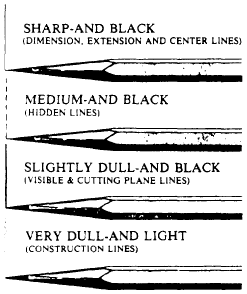
Figure 5-58.-Use of paper, pad, or table as a guide when drawing straight lines. of your pencil on the paper. Hold the pencil about three quarters of an inch to an inch from the point so that you can see what you are doing. Strive for a free and easy movement rather than a cramped finger and wrist movement.Another useful technique in drawing straight lines is to use the side of the paper, pad, or table as a guide for your hand. Hold the pencil at the desired starting point of the line and place the heel of your hand and one finger on the guide, as shown in figure 5-58. Move the pencil, in this case, with one uniform stroke to complete the line. Try drawing several light horizontal lines and, after each one is drawn, examine it for straightness, weight, and neatness. If it is too light, use either a softer pencil or a little more pressure.Vertical lines are usually sketched downward on the paper. The same suggestions for using locator dots, free movement of the entire arm, and guides apply to vertical lines as they do to horizontal lines.Slanting lines may be drawn from either end toward the other. For better control, you might find it helpful to rotate the paper, thus placing the desired slanting line in either the horizontal or vertical position.To keep your sketch neat, first sketch your lines lightly. Lines not essential to the drawing can be sketched so lightly that you need not erase them. Darken essential lines by running your pencil over them with more pressure. Figure 5-59 shows line conventions drawn with various types of pencil points.
Figure 5-59.-Line conventions drawn with various types of pencil points.
Figure 5-60.-Bisecting a line by visual comparison.
Figure 5-61.-Locating centers by sketching diagonals.
Figure 5-62.-Sketching angles by visual comparison. |
||
|
||