Custom Search
|
|
 
|
||
|
Fission of heavy nuclides converts a small amount of mass into an enormous amount of energy. The amount of energy released by fission can be determined based on either the change in mass that occurs during the reaction or by the difference in binding energy per nucleon between the fissile nuclide and the fission products. EO 4.8CHARACTERIZE the fission products in terms of mass groupings and radioactivity. EO 4.9Given the nuclides involved and their masses, CALCULATE the energy released from fission. EO 4.10 Given the curve of Binding Energy per nucleon versus mass number, CALCULATE the energy released from fission. Calculation of Fission Energy Nuclear fission results in the release of enormous quantities of energy. It is necessary to be able to calculate the amount of energy that will be produced. The logical manner in which to pursue this is to first investigate a typical fission reaction such as the one listed below.
It can be seen that when the compound nucleus splits, it
breaks into two fission fragments, rubidium-93, cesium-140, and some neutrons.
Both fission products then decay by multiple In most cases, the resultant fission fragments have masses that vary widely. Figure 21 gives the percent yield for atomic mass numbers. The most probable pair of fission fragments for the thermal fission of the fuel uranium-235 have masses of about 95 and 140. Note that the vertical axis of the fission yield curve is on a logarithmic scale. Therefore, the formation of fission fragments of mass numbers of about 95 and 140 is highly likely.
Figure 21 Uranium-235 Fission Yield vs. Mass Number Referring now to the binding energy per nucleon curve
(Figure 20), we can estimate the amount of energy released by our
"typical" fission by plotting this reaction on the curve and
calculating the change in binding energy (
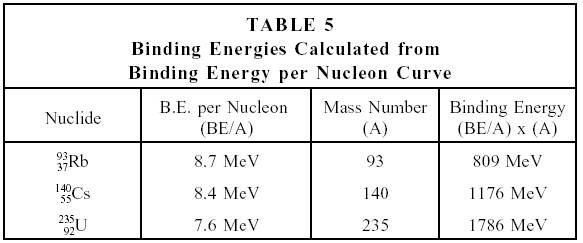
Figure 22 Change in Binding Energy for Typical Fission Figure 22 graphically depicts that the binding energy per nucleon for the products (C, rubidium-93 and B, cesium-140) is greater than that for the reactant (A, uranium-235). The total binding energy for a nucleus can be found by multiplying the binding energy per nucleon by the number of nucleons.
The energy released will be equivalent to the difference
in binding energy (
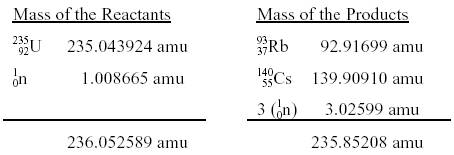
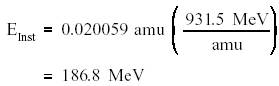
The energy liberation during the fission process can also be explained from the standpoint of the conservation of mass-energy. During the fission process, there is a decrease in the mass of the system. There must, therefore, be energy liberated equal to the energy equivalent of the mass lost in the process. This method is more accurate than the previously illustrated method and is used when actually calculating the energy liberated during the fission process. Again, referring to the "typical" fission reaction.
This mass difference can be converted to an energy equivalent
The total energy released per fission will vary from the fission to the next depending on what fission products are formed, but the average total energy released per fission of uranium-235 with a thermal neutron is 200 MeV. As illustrated in the preceding example, the majority of the energy liberated in the fission process is released immediately after the fission occurs and appears as the kinetic energy of the fission fragments, kinetic energy of the fission neutrons, and instantaneous gamma rays. The remaining energy is released over a period of time after the fission occurs and appears as kinetic energy of the beta, neutrino, and decay gamma rays. |
 |
|
|
||
|
|
Integrated Publishing, Inc. - A (SDVOSB) Service Disabled Veteran Owned Small Business
|













 emissions as a result of the high
neutron-to-proton ratio possessed by these nuclides.
emissions as a result of the high
neutron-to-proton ratio possessed by these nuclides.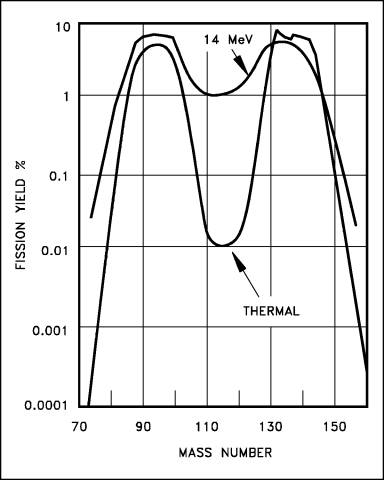
 BE)
between the reactants on the left-hand side of the fission equation and the
products on the right-hand side. Plotting the reactant and product nuclides on
the curve shows that the total binding energy of the system after fission is
greater than the total binding energy of the system before fission. When there
is an increase in the total binding energy of a system, the system has become
more stable by releasing an amount of energy equal to the increase in total
binding energy of the system. Therefore, in the fission process, the energy
liberated is equal to the increase in the total
BE)
between the reactants on the left-hand side of the fission equation and the
products on the right-hand side. Plotting the reactant and product nuclides on
the curve shows that the total binding energy of the system after fission is
greater than the total binding energy of the system before fission. When there
is an increase in the total binding energy of a system, the system has become
more stable by releasing an amount of energy equal to the increase in total
binding energy of the system. Therefore, in the fission process, the energy
liberated is equal to the increase in the total 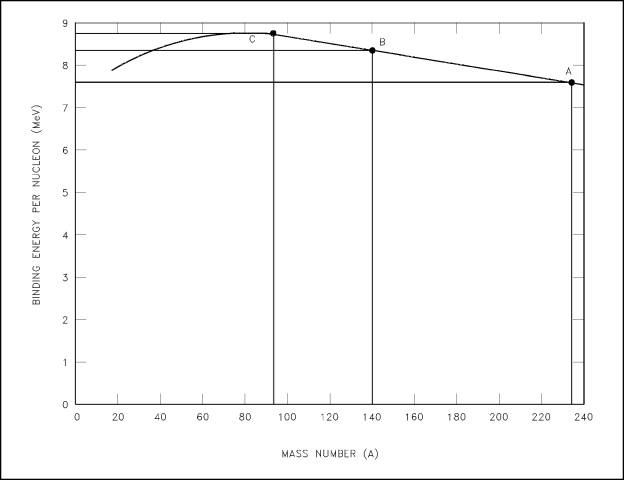
 BE)
between the reactants and the products.
BE)
between the reactants and the products.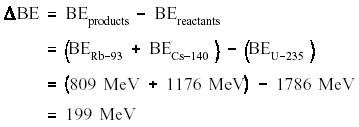

 ,
,