Order this information in Print

Order this information on CD-ROM

Download in PDF Format


Click here to make tpub.com your Home Page

Page Title: Adipose Connective Tissue
Back | Up | Next

tpub.com Updates

Google


Web
www.tpub.com

Home

   
Information Categories
.... Administration
Advancement
Aerographer
Automotive
Aviation
Combat
Construction
Diving
Draftsman
Engineering
Electronics
Food and Cooking
Math
Medical
Music
Nuclear Fundamentals
Photography
Religion
USMC
   
Products
  Educational CD-ROM's
Printed Manuals
Downloadable Books


Back
Areolar Connective Tissue
Up
Content Moved
Next
Cardiac Muscle Tissue

Back ] Home ] Up ] Next ]

Adipose Connective Tissue
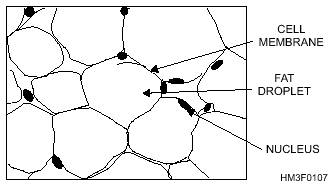
Adipose tissue is "fatty tissue." The adipose cell at first appears star-shaped. When the cell begins to store fat in its cytoplasm, it enlarges, losing its star shape as the nucleus is pushed to one side (fig. 1-7). When this process occurs to many cells, the other cell types are crowded out and adipose tissue is formed. Adipose tissue is found beneath skin, between muscles, and around joints and various organs of the body. Adipose tissue acts as a reservoir for energy-producing foods; helps to reduce body heat loss (because of its poor heat conductivity); and serves as support for various organs and fragile structures, such as the kidneys, blood vessels, and nerves.

Osseous Connective Tissue
This type of tissue, known as "bone tissue," is a dense fibrous connective tissue that forms tendons, ligaments, cartilage, and bones (fig. 1-8). These tissues form the supporting framework of the body.

MUSCULAR TISSUE
Muscular tissue provides for all body movement. Contracting muscles cause body parts to move. The three types of muscle tissue are skeletal, smooth, and cardiac.

Skeletal Muscle Tissue
Skeletal (voluntary) muscle fiber is striated, or striped, and is under the control of the individual's will (fig. 1-9). For this reason, it is often called "voluntary" muscle tissue. Skeletal muscle tissues are usually attached to bones. When muscle fibers are stimulated by an action of a nerve fiber, the fibers contract and relax. This interaction between muscle and nervous fibers produces movement.

Smooth Muscle Tissue
These muscle fibers are smooth, or nonstriated, and are not under the control of the individual's will (fig. 1-10). For this reason, this type of muscle tissue is called "involuntary." Smooth muscle tissue is found in the walls of hollow organs, such as the stomach, intestines, blood vessels, and urinary bladder. Smooth muscle tissues are responsible for the movement of food through the digestive system, constricting blood vessels, and emptying the bladder.

Figure 1-7.-Adipose connective tissue.

Figure 1-8.-Osseous (bone) connective tissue.

Figure 1-9.-Skeletal muscle tissue.

Figure 1-10.-Smooth muscle tissue. 

Back ] Home ] Up ] Next ]

This information is now available on CD in Adobe PDF Printable Format


Privacy Statement - Press Release - Copyright Information. - Contact Us - Support Integrated Publishing