Order this information in Print

Order this information on CD-ROM

Download in PDF Format


Click here to make tpub.com your Home Page

Page Title: Wing twist check
Back | Up | Next

tpub.com Updates

Google


Web
www.tpub.com

Home

   
Information Categories
.... Administration
Advancement
Aerographer
Automotive
Aviation
Combat
Construction
Diving
Draftsman
Engineering
Electronics
Food and Cooking
Math
Medical
Music
Nuclear Fundamentals
Photography
Religion
USMC
   
Products
  Educational CD-ROM's
Printed Manuals
Downloadable Books


Back
Plumb Bob and Datum Plate
Up
Content Moved
Next
Chapter 10 - Rotary-wing flight control systems

Back ] Home ] Up ] Next ]

WING TWIST CHECK

With the aircraft leveled and the wings folded, it is possible to check the wings for twist. One checkpoint is provided on each wing. Clinometer readings taken at these points, when compared to the fuselage longitudinal clinometer readings, will enable you to determine the condition of each wing. This is possible because there is a definite relationship between the fuselage longitudinal and wing reference


Figure 9-45.—Plumb bob and datum plate leveling.


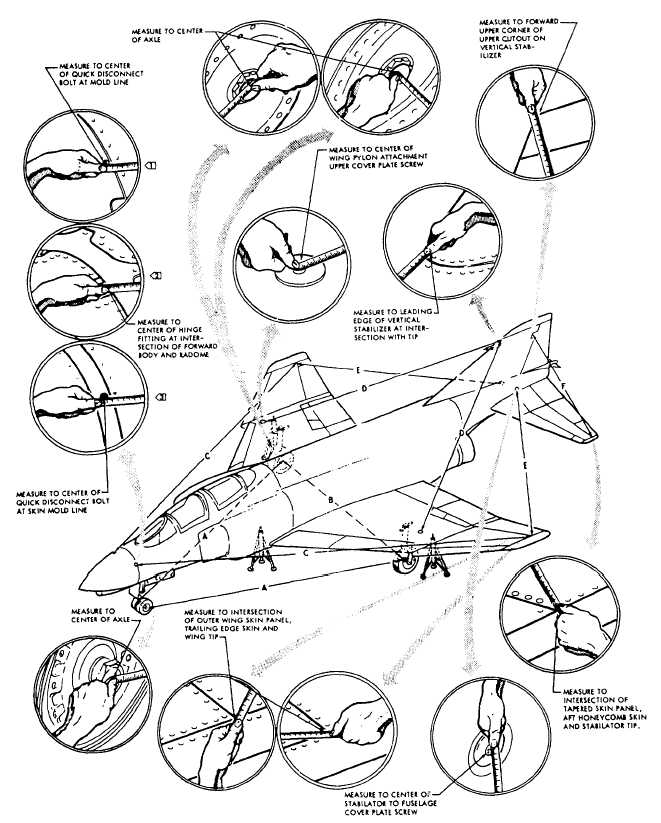
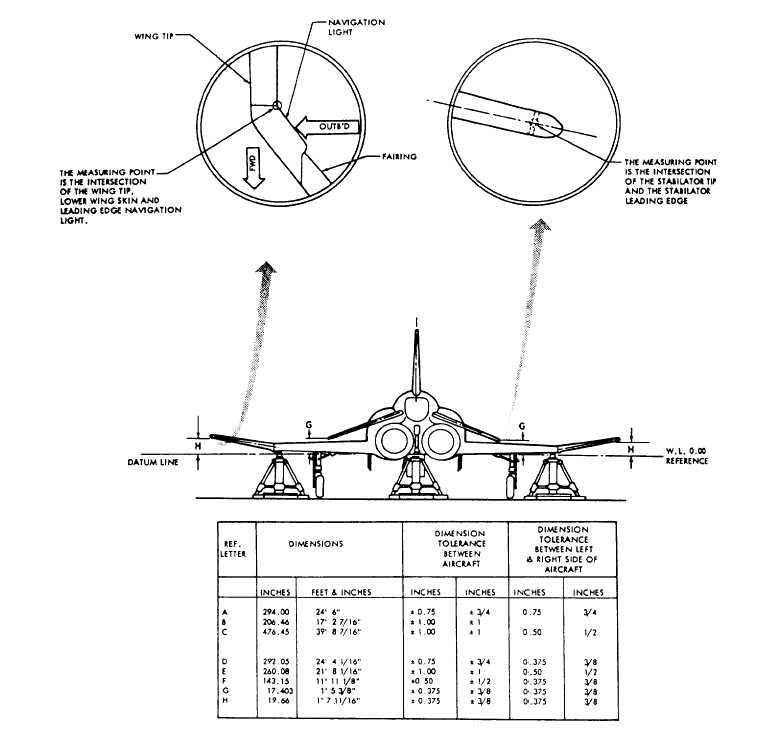
Figure 9-46.—Aircraft alignment data.


Figure 9-47.-Aircraft alignment data and measurement chart.

lines. You should follow the following steps to perform a wing twist check: 

1. Fold the wings and level the aircraft laterally. 

2. Install the leveling bar in the forward lockpin holes of the outboard panel fold rib. 

3. Turn the rod until the milled flat at the forward end is straight up.

4. Set the clinometer on the flat and record the reading when the dial has stopped rotating.

The right- and left-hand wing readings must be within 0 degrees, 12 minutes of each other for acceptable aerodynamic tolerances with respect to twist. They must also fall within the following upper and lower limits. The lower limit is established by subtracting 0 degrees, 20 minutes from the


Figure 9-48.—Alignment data—wing twist check.

 longitudinal reading, and the upper limit is established by adding 0 degrees, 40 minutes to the longitudinal reading taken in the auxiliary wheel well. For example, if the longitudinal reading was 1 degree, 35 minutes, the lower limit would be 1 degree, 15 minutes, and the upper limit would be 2 degrees, 15 minutes. Figure 9-48 shows a wing twist check on an aircraft. The wing clinometer readings must fall within this range as well as within 0 degree, 12 minutes of each other (right- to left-hand wing readings). This check, together with the steel tape measurements taken when the wings are spread, is a satisfactory check of wing bending and twisting. If the clinometer readings and tape measurements arc not within the tolerances specified, the aircraft must be taken to a depot-level maintenance facility for a complete inspection and final disposition.

RECOMMENDED READING LIST

NOTE: Although the following References were current when this TRAMAN was published, their continued currency cannot be assured. Therefore, you need to be sure that you are studying the latest revision.

General Manual for Structural Repair, NAVAIR 01-1A-1, Commander, Naval Air Systems Command, Washington, D.C., 15 July 1969, Change 11, 15 August 1989, Section II.

Privacy Statement - Press Release - Copyright Information. - Contact Us - Support Integrated Publishing