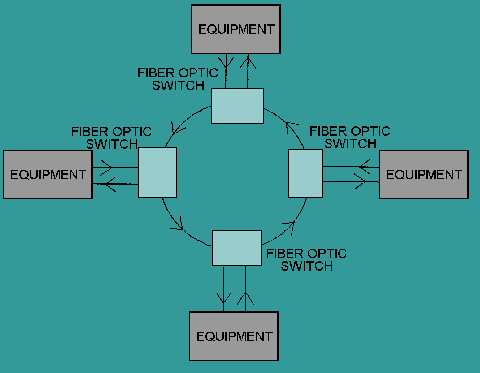

Q2.Which topology (linear bus, ring, star, or tree) consists of equipments attached to one another in a closed loop?
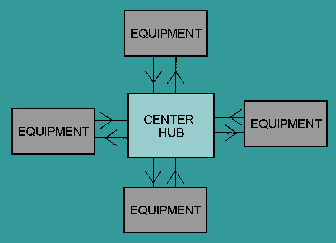
Q3.Which topology (bus, ring, star, or tree) has a center hub interconnecting the equipments?
CHAPTER 8
FIBER OPTIC LINKS
LEARNING OBJECTIVES
Upon completion of this chapter, you should be able to do the following:
1. Describe a basic point-to-point fiber optic data link.
2. Explain the difference between digital and analog fiber optic communications systems.
3. Discuss the most common types of line coding used in digital fiber optic communications including non-return-to-zero (NRZ), return-to-zero (RZ), and biphase (or Manchester).
4. Describe the main type of analog modulation.
5. State several precautions that need to be emphasized when installing fiber optic links on board ships.
FIBER OPTIC SYSTEM TOPOLOGY
Most of the discussion on fiber optic data links provided earlier in this training manual refers to simple point-to-point links. A point-to-point fiber optic data link consists of an optical transmitter, optical fiber, and an optical receiver. In addition, any splices or connectors used to join individual optical fiber sections to each other and to the transmitter and the receiver are included. Figure 8-1 provides a schematic diagram of a point-to-point fiber optic data link.
Figure 8-1.=A schematic diagram of a point-to-point fiber optic data link.
A common fiber optic application is the full duplex link. This link consists of two
simple point-to-point links. The links transmit in opposite directions between the
equipments. This application may be configured using only one fiber. If configured with
one fiber, fiber optic splitters are used at each end to couple the transmit signal onto
the fiber and receive signal to the detector.
All fiber optic systems are simply sets of point-to-point fiber optic links. Different
system topologies arise from the different ways that point-to-point fiber optic links can
be connected between equipments. The term topology, as used here, refers to the
configuration of various equipments and the fiber optic components interconnecting them.
This equipment may be computers, workstations, consoles, or other equipments.
Point-to-point links are connected to produce systems with linear bus, ring, star, or tree
topologies. Point-to-point fiber optic links are the basic building block of all fiber
optic systems.
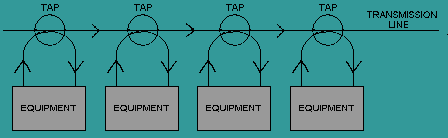
A linear bus topology consists of a single transmission line that is shared by a number of equipments (see figure 8-2). Generally the transmission line in a fiber optic linear bus consists of two optical lines, one for each direction of communication. Optical taps (optical splitters) are used by each equipment to connect to each line. For each line, the optical tap couples signals from the line to the equipment receiver and from the equipment transmitter onto the line. The connection between any two equipments is a simple point-to-point link that contains the optical tap for each equipment.
Figure 8-2.=Linear bus topology.
A ring topology consists of equipments attached to one another in a closed loop or ring (see figure 8-3).The connection between each equipment is a simple point-to-point link. In some systems each equipment may have an associated optical switch. In normal operation, the switch routes signals from the fiber connected to the previous equipment to the receiver. It also routes signals from the transmitter to the fiber connected to the next equipment. In bypass operation, the switch routes signals from the fiber connected to the previous equipment to the fiber connected to the next equipment. In each case, the connection between adjacent equipments on the ring is a simple point-to-point link through fiber, connectors, and switches.
In the star topology, each equipment is connected to a common center hub (see figure 8-4).The center hub can be a passive fiber optic star coupler or an active equipment. If the center hub is a passive star coupler, each equipment transmitter is connected to an input port of the coupler and an output port of the coupler is connected to each equipment receiver. The connection between any two equipments is a simple point-to-point link through the star coupler. If the center hub is an active equipment, the connection between any two equipments consists of two point-to-point links. Each connection consists of one link from the first equipment to the center hub and a second link from the center hub to the second equipment.
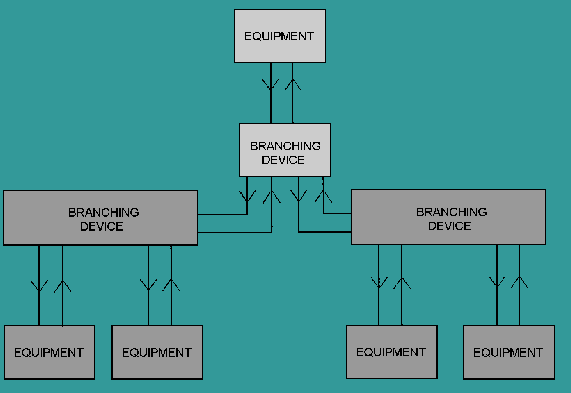
A tree topology consists of a transmission line that branches, or splits (see figure 8-5). A tree topology may have many different branching points. At each branching point either a passive fiber optic splitter or an active branching device is used. In many cases both passive couplers and active branching devices are used within a particular system. Regardless of the branching method, each connection within the tree is a simple point-to-point link through splitters or multiple point-to-point links through active branching devices.
Q1.List four system topologies that can be constructed using point-to-point fiber optic
links.
Q2.Which topology (linear bus, ring, star, or tree) consists of equipments attached to one
another in a closed loop?
Q3.Which topology (bus, ring, star, or tree) has a center hub interconnecting the
equipments?
LINK CLASSIFICATION
While there are several ways to classify fiber optic links, this chapter classifies links according to the modulation type: either digital or analog. Modulation is the process of varying one or more characteristics of an optical signal to encode and convey information. Generally, the intensity of the optical signal is modulated in fiber optic communications systems. Digital modulation implies that the optical signal consists of discrete levels. Analog modulation implies that the intensity of the optical signal is proportional to a continuously varying electrical input. Most fiber optic systems are digital because digital transmission systems generally provide superior performance over analog transmission systems.
Q4.Define modulation.
DIGITAL TRANSMISSION
A digital signal is a discontinuous signal that changes from one state to another in discrete steps. A popular form of digital modulation is binary, or two level, digital modulation. In binary modulation the optical signal is switched from a low-power level (usually off) to a high-power level. There are a number of modulation techniques used in digital systems, but these will not be discussed here. For more information on digital modulation techniques, refer to the References listed in appendix 2.
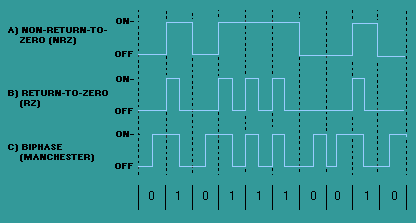
Line coding is the process of arranging symbols that represent binary data in a particular pattern for transmission. The most common types of line coding used in fiber optic communications include non-return-to-zero (NRZ), return-to-zero (RZ), and biphase, or Manchester. Figure 8-6 illustrates NRZ, RZ, and biphase (Manchester) encoding.
Figure 8-6.=NRZ, RZ, and biphase (Manchester) encoding.
NRZ code represents binary 1s and 0s by two different light levels that are constant during a bit duration. The presence of a high-light level in the bit duration represents a binary 1, while a low-light level represents a binary 0. NRZ codes make the most efficient use of system bandwidth. However, loss of timing may result if long strings of 1s and 0s are present causing a lack of level transitions.
RZ coding uses only half the bit duration for data transmission. In RZ encoding, a half period optical pulse present in the first half of the bit duration represents a binary 1. While an optical pulse is present in the first half of the bit duration, the light level returns to zero during the second half. A binary 0 is represented by the absence of an optical pulse during the entire bit duration. Because RZ coding uses only half the bit duration for data transmission, it requires twice the bandwidth of NRZ coding. Loss of timing can occur if long strings of 0s are present.
Biphase, or Manchester, encoding incorporates a transition into each bit period to maintain timing information. In Manchester encoding, a high-to-low light level transition occurring in the middle of the bit duration represents a binary 1. A low-to-high light level transition occurring in the middle of the bit duration represents a binary 0.
For further information on digital encoding schemes and modulation techniques, refer to the reference material listed in appendix 2.
Digital transmission offers an advantage with regard to the acceptable signal-to-noise ratio (SNR) at the optical receiver. Digital communications systems can tolerate large amounts of signal loss and dispersion without impairing the ability of the receiver to distinguish a binary 1 from a binary 0. Digital signalling also reduces the effects that optical source nonlinearities and temperature have on system performance. Source nonlinearities and temperature variations can severely affect analog transmission. Digital transmission provides superior performance in most complex systems (such as LANs) and long-haul communications systems. In short-haul systems, the cost and complexity of analog-to-digital and digital-to-analog conversion equipment, in some cases, outweigh the benefits of digital transmission.
Q5.What is a digital signal?
Q6.In NRZ code, does the presence of a high-light level in the bit duration represent a
binary 1 or a binary 0?
Q7.How can the loss of timing occur in NRZ line coding?
Q8.How is a binary 1 encoded in RZ line coding?
Q9.In Manchester encoding, does a low-to-high light level transition occurring in the
middle of the bit duration represent a binary 1 or a binary 0?
ANALOG TRANSMISSION
An analog signal is a continuous signal whose amplitude, phase, or some other property varies in a direct proportion to the instantaneous value of a physical variable. An example of an analog signal is the output power of an optical source whose intensity is a function of a continuous electrical input signal.
Most analog fiber optic communications systems intensity modulate the optical source. In intensity modulation, the intensity of the optical source's output signal is directly modulated by the incoming electrical analog baseband signal. A baseband signal is a signal that is in its original form and has not been changed by a modulation technique.
In some cases, the optical source may be directly modulated by a incoming electrical signal that is not a baseband signal. In these cases the original electrical signal generally modulates an electrical subcarrier frequency. The most common form of analog subcarrier modulation in fiber optic systems is frequency modulation (FM). The optical source is intensity modulated by the electrical subcarrier.
While most fiber optic systems employ digital modulation techniques, there are certain applications where analog modulation techniques are preferred. The transmission of video using analog techniques is very popular, especially for shorter distances, where costs can be minimized and complex multiplexing and timing equipment is unnecessary. The transmission of analog voice signals may also be attractive in small, short-haul systems. In addition, fiber optic sensor systems may incorporate analog transmission. Requirements that analog transmission places on applications include high signal-to-noise ratio and high source linearity. While analog transmission can be attractive for short-haul or medium-haul systems, it is unattractive for long-haul systems where digital techniques provide better performance.
Q10.What is an analog signal?
Q11.What type of modulation do most analog fiber optic communications systems use?
Q12.Why has the transmission of video using analog techniques been very popular,
especially for shorter distances?
SYSTEM DESIGN
Fiber optic systems can be simple point-to-point data links or can involve more complex topologies. However, it is generally necessary only to refer to point-to-point data links when discussing the process of link design. Fiber optic systems that incorporate complex architectures can be simplified into a collection of point-to-point data links before beginning the design process.
Fiber optic system design is a complicated process that involves link definition and analysis. The design process begins by providing a complete description of the communication requirements. This information is used to develop the link architecture and define the communications links. System designers must decide on the operational wavelength and types of components to use in the system. These decisions affect numerous system and link design parameters, such as launched power, connection losses, bandwidth, cost, and reliability.
Once a system design has been formulated, each link is analyzed to determine its viability. Link analysis involves calculating each link's power budget and risetime budget. Calculating a power budget involves identifying all of the sources of loss in the fiber optic link. These losses and an additional safety margin are then compared to the difference between the transmitter output power and the receiver sensitivity. The difference between the transmitter output power and the receiver sensitivity is referred to as the available power. If the sources of loss plus the safety margin are less than the available power in the link, the design is viable.
Calculating the risetime budget involves calculating the risetimes of the link transmitter and the optical fiber. The composite optical transmitter/fiber risetime is referred to as the fiber exit risetime. If the fiber exit risetime is less than the maximum input risetime specified for the link receiver, then the link design is viable.
If a proposed link design is not viable, the system designer will reevaluate various decisions made earlier in the system design. These reevaluations may include using a different transmitter or receiver or may involve redesigning the physical configuration of the link. Because there are many variables involved in link design and analysis, it may take several iterations before the variables are combined in a manner that ensures link operation. For more information of fiber optic system design, refer to the Navy Fiber Optic System Design Standard.
Q13.Why is it generally only necessary to refer to point-to-point data links when
discussing the process of fiber optic system design?
Q14.List five system design parameters considered when system designers choose the system
operational wavelength and link components.
Q15.What two analyses are performed to determine if a link design is viable?
SYSTEM INSTALLATION
The Navy has a standard to provide detailed information and guidance to personnel concerned with the installation of fiber optic cable plants on naval surface ships and submarines. The fiber optic cable plant consists of all the fiber optic cables and the fiber optic interconnection equipment within the ship, including connectors, splices, and interconnection boxes. The fiber optic cable plant installation standard consists of a basic standard and six numbered parts dealing with the following:
Cables-provides detailed methods for cable storage and handling, end-sealing, repair, and splicing
Equipment-provides detailed methods for fiber optic equipment installation and cable entrance to equipment
Penetrations-provides detailed methods for cable penetrations within the ship's structure
Cableways-provides detailed methods to install fiber optic cables in cableways
Connectors and interconnections-provides detailed methods for installing fiber optic connectors and other interconnections, such as splices
Tests-identifies and provides detailed methods for testing fiber optic cable plants before, during, and after installation and repair
There are other standards that discuss fiber optic system installation. Many of these standards incorporate procedures for repair, maintenance, and testing. The techniques developed for installing fiber optic hardware are not much different than for installing hardware for copper-based systems. However, the primary precautions that need to be emphasized when installing fiber optic systems on board ships are as follows:
Optical fibers or cables should never be bent at a radius of curvature less than a certain value, called the minimum bend radius. Bending an optical fiber or cable at a radius smaller than the minimum bend radius causes additional fiber loss.
Fiber optic cables should never be pulled tight or fastened over or through sharp corners or cutting edges. Extremely sharp bends increase the fiber loss and may lead to fiber breakage.
Fiber optic connectors should always be cleaned before mating. Dirt in a fiber optic connection will significantly increase the connection loss and may damage the connector.
Precautions must be taken so the cable does not become kinked or crushed during installation of the hardware. Extremely sharp kinks or bends increase the fiber loss and may lead to fiber breakage.
Only trained, authorized personnel should be allowed to install or repair fiber optic systems.
Q16.Optical fibers or cables should never be bent at a radius of curvature smaller than
a certain value. Identify this radius of curvature.
Q17.List five precautions to take when installing fiber optic systems on board naval
ships.
SUMMARY
Now that you have completed this chapter, let's review some of the new terms, concepts, and ideas that you have learned. Understanding the basics of fiber optic system classification, design, and installation is recommended before you begin studying specific fiber optic system applications.
A basic POINT-TO-POINT fiber optic data link consists of an optical transmitter, optical fiber, and an optical receiver. In addition, any splices or connectors used to join individual optical fiber sections to each other and to the transmitter and the receiver are included.
The term TOPOLOGY refers to the configuration of various equipments and the fiber optic components interconnecting them.
A LINEAR BUS TOPOLOGY consists of a single transmission line that is shared by a number of equipments.
A RING TOPOLOGY consists of equipments attached to one another in a closed loop or ring.
In the STAR TOPOLOGY, each equipment is connected to a common center hub. The center hub can be a passive fiber optic star coupler or an active equipment.
A TREE TOPOLOGY consists of a transmission line that branches, or splits.
FIBER OPTIC LINKS are classified according to the modulation type: either digital or analog.
DIGITAL MODULATION implies that the optical signal consists of discrete levels.
ANALOG MODULATION implies that the intensity of the optical signal is proportional to a continuously varying electrical input.
MODULATION is the process of varying one or more characteristics of an optical signal to encode and convey information.
A DIGITAL SIGNAL is a discontinuous signal that changes from one state to another in discrete steps.
BINARY, or two level, digital modulation is a popular form of digital modulation.
LINE CODING is the process of arranging symbols that represent binary data in a particular pattern for transmission. The most common types of line coding used in fiber optic communications include non-return-to-zero (NRZ), return-to-zero (RZ), and biphase, or Manchester.
DIGITAL TRANSMISSION offers an advantage with regard to the acceptable SNR at the optical receiver.
An ANALOG SIGNAL is a continuous signal that varies in a direct proportion to the instantaneous value of a physical variable.
Most ANALOG FIBER OPTIC COMMUNICATIONS SYSTEMS intensity modulate the optical source.
In INTENSITY MODULATION, the intensity of the optical source's output signal is directly modulated by the incoming electrical analog baseband signal.
A BASEBAND SIGNAL is a signal that is in its original form and has not been changed by a modulation technique.
FIBER OPTIC SYSTEMS that have complex architectures can be simplified into a collection of point-to-point data links.
LINK ANALYSIS involves calculating each link's power budget and risetime budget.
Calculating a POWER BUDGET involves identifying all of the sources of loss in the fiber optic link. These losses and an additional safety margin are then compared to the difference between the transmitter output power and the receiver sensitivity.
Calculating the RISETIME BUDGET involves calculating the risetimes of the link transmitter and the optical fiber.
The FIBER OPTIC CABLE PLANT consists of all the fiber optic cables and the fiber optic interconnection equipment within the ship, including connectors, splices, and interconnection boxes.
OPTICAL FIBERS OR CABLES should never be bent at a radius of curvature less than a certain value, called the minimum bend radius.
FIBER OPTIC CONNECTORS should always be cleaned before mating.