|
||
|
|
||
| |||||||||||||||
|
|
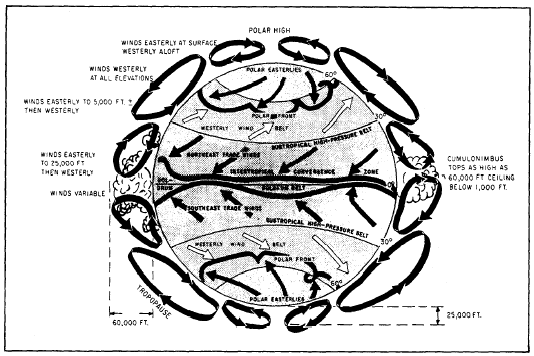
Click here to Order your Radar Equipment Online WORLD WINDS In the vicinity of the equator is a belt of light and variable winds known as the doldrums. On the poleward side of the doldrums are the TRADE WINDS; the predominant wind system of the tropics. These easterly winds are the most consistent on Earth, especially over the oceans. Near 30N and 30S latitudes lie the sub-tropic high-pressure belts. Winds are light and variable. These areas are referred to as the HORSE LATITUDES. The prevailing westerlies, which are on the poleward side of the subtropical high-pressure belt, are persistent throughout the mid-latitudes. In the Northern Hemisphere, the direction of the westerlies at the surface is from the southwest. In the Southern Hemisphere, westerlies are from
Figure 3-1-6.Idealized
pattern of the general circulation. (The 3-cell theory.)
the northwest. This is due to the deflection
resulting from the Coriolis effect as the air moves poleward.
Poleward of the prevailing westerlies, near 60N and 60S latitudes, lies the belt of low pressure known as the polar front zone. Here, converging winds result in ascending air currents and consequent poor weather. Learning Objective: Describe how geostrophic wind, gradient wind, cyclos-trophic wind, and fronts affect the direc-tion of the wind. |
|
Privacy Statement - Press Release - Copyright Information. - Contact Us - Support Integrated Publishing |