Custom Search
|
|
  |
|
|
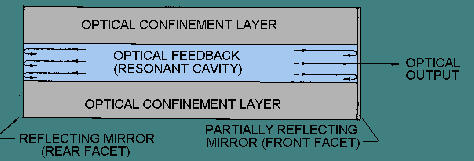
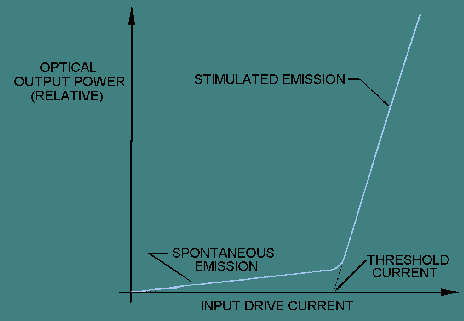
LASER DIODES A laser is a device that produces optical radiation by the process of stimulated emission. It is necessary to contain photons produced by stimulated emission within the laser active region. Figure 6-3 shows an optical cavity formed to contain the emitted photons by placing one reflecting mirror at each end of an amplifying medium. One mirror is made partially reflecting so that some radiation can escape from the cavity for coupling to an optical fiber. Figure 6-3. - Optical cavity for producing lasing. Only a portion of the optical radiation is amplified. For a particular laser structure, there are only certain wavelengths that will be amplified by that laser. Amplification occurs when selected wavelengths, also called laser modes, reflect back and forth through the cavity. For lasing to occur, the optical gain of the selected modes must exceed the optical loss during one round-trip through the cavity. This process is referred to as optical feedback. The lasing threshold is the lowest drive current level at which the output of the laser results primarily from stimulated emission rather than spontaneous emission. Figure 6-4 illustrates the transition from spontaneous emission to stimulated emission by plotting the relative optical output power and input drive current of a semiconductor laser diode. The lowest current at which stimulated emission exceeds spontaneous emission is the threshold current. Before the threshold current is reached, the optical output power increases only slightly with small increases in drive current. However, after the threshold current is reached, the optical output power increases significantly with small changes in drive currents.
Figure 6-4. - The optical output power as a function of input drive current of a semiconductor laser diode.
Many types of materials including gas, liquid, and semiconductors can form the lasing medium. However, in this chapter we only discuss semiconductor laser diodes. Semiconductor laser diodes are the primary lasers used in fiber optics. A laser diode emits light that is highly monochromatic and very directional. This means that the LD's output has a narrow spectral width and small output beam angle. A semiconductor LD's geometry is similar to an ELED with light-guiding regions surrounding the active region. Optical feedback is established by making the front facet partially reflective. This chapter provides no diagram detailing LD structures because they are similar to ELEDs in design. The rear facet is typically coated with a reflective layer so that all of the light striking the facet is reflected back into the active region. The front facet is typically left uncoated so that most of the light is emitted. By increasing the drive current, the diode becomes a laser. At currents below the threshold current, LDs function as ELEDs. To optimize Frequency response, laser diodes are often biased above this laser threshold. As a result, in an LD fiber optic system, light is modulated between a high power level and a lower power level, but never shut off. LDs typically can be modulated at frequencies up to over 2 gigahertz (GHz). Some lasers are capable of being modulated at frequencies over 20 GHz. There are several important differences between LDs and LEDs. One is that LEDs usually lack reflective facets and in some cases are designed to suppress reflections back into the active region. Another is that lasers tend to operate at higher drive currents to produce light. A higher driver current results in more complicated drive circuits and more heat dissipation in the device. LDs are also much more temperature sensitive than either SLEDs or ELEDs. Increases in the laser temperature significantly reduce laser output power. Increases in laser temperature beyond certain limits result in the loss of lasing. When lasers are used in many applications, the temperature of the laser must be controlled. Typically, electronic coolers, called thermo-electric (TE) coolers, are used to cool LDs in system applications. |
 
|