Custom Search
|
|
  |
|
|
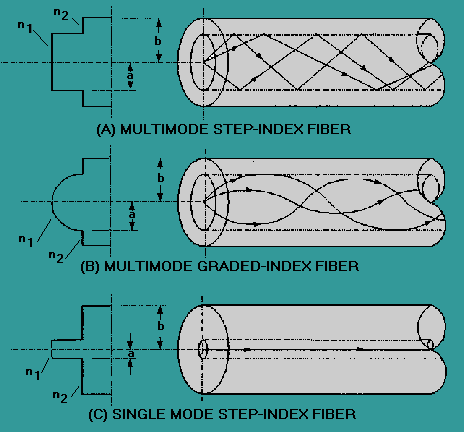
OPTICAL FIBERS AND CABLES LEARNING OBJECTIVES Upon completion of this chapter, you should be able to do the following: OPTICAL FIBER AND CABLE DESIGN Optical fibers are thin cylindrical dielectric (non-conductive) waveguides used to send light energy for communication. Optical fibers consist of three parts: the core, the cladding, and the coating or buffer. The choice of optical fiber materials and fiber design depends on operating conditions and intended application. Optical fibers are protected from the environment by incorporating the fiber into some type of cable structure. Cable strength members and outer jackets protect the fiber. Optical cable structure and material composition depend on the conditions of operation and the intended application. OPTICAL FIBERS Chapter 2 classified optical fibers as either single mode or multimode fibers. Fibers are classified according to the number of modes that they can propagate. Single mode fibers can propagate only the fundamental mode. Multimode fibers can propagate hundreds of modes. However, the classification of an optical fiber depends on more than the number of modes that a fiber can propagate. An optical fiber's refractive index profile and core size further distinguish single mode and multimode fibers. The refractive index profile describes the value of refractive index as a function of radial distance at any fiber diameter. Fiber refractive index profiles classify single mode and multimode fibers as follows: In a step-index fiber, the refractive index of the core is uniform and undergoes an abrupt change at the core-cladding boundary. Step-index fibers obtain their name from this abrupt change called the step change in refractive index. In graded-index fibers, the refractive index of the core varies gradually as a function of radial distance from the fiber center. Single mode and multimode fibers can have a step-index or graded-index refractive index profile. The performance of multimode graded-index fibers is usually superior to multimode step-index fibers. However, each type of multimode fiber can improve system design and operation depending on the intended application. Performance advantages for single mode graded-index fibers compared to single mode step-index fibers are relatively small. Therefore, single mode fiber production is almost exclusively step-index. Figure 3-1 shows the refractive index profile for a multimode step-index fiber and a multimode graded-index fiber. Figure 3-1 also shows the refractive index profile for a single mode step-index fiber. Since light propagates differently in each fiber type, figure 3-1 shows the propagation of light along each fiber. Figure 3-1. - The refractive index profiles and light propagation in multimode step-index, multimode graded-index, and single mode step-index fibers.
In chapter 2, you learned that fiber core size and material composition can affect system performance. A small change in core size and material composition affects fiber transmission properties, such as attenuation and dispersion. When selecting an optical fiber, the system designer decides which fiber core size and material composition is appropriate. Standard core sizes for multimode step-index fibers are 50 μm and 100 μm. Standard core sizes for multimode graded-index fibers are 50 μm, 62.5 μm, 85 μm, and 100 μm. Standard core sizes for single mode fibers are between 8 μm and 10 μm. In most cases, the material used in the preparation of optical fibers is high-quality glass (SiO2). This glass contains very low amounts of impurities, such as water or elements other than silica and oxygen. Using high-quality glass produces fibers with low losses. Small amounts of some elements other than silica and oxygen are added to the glass material to change its index of refraction. These elements are called material dopants. Silica doped with various materials forms the refractive index profile of the fiber core and material dopants are discussed in more detail later in this chapter. Glass is not the only material used in fabrication of optical fibers. Plastics are also used for core and cladding materials in some applications. A particular optical fiber design can improve fiber optic system performance. Each single mode or multimode, step-index or graded-index, glass or plastic, or large or small core fiber has an intended application. The system designer must choose an appropriate fiber design that optimizes system performance in his application. Q.1 Describe the term "refractive index profile." |
 
|