Custom Search
|
|
  |
|
|
INTRODUCTION TO WAVEFORM INTERPRETATION LEARNING OBJECTIVES Upon completion of this chapter, you will be able to do the following:
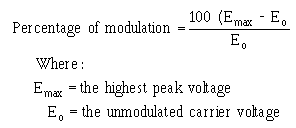
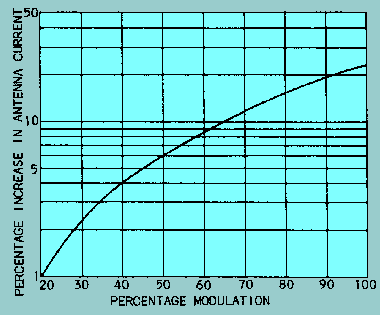
INTRODUCTION TO WAVEFORM INTERPRETATION Measurements performed with oscilloscopes, time-domain reflectometers, and spectrum analyzers enable you to view the signal produced by the equipment or circuit under test. However, a visual display is of no value unless you are able to interpret the signal characteristics. A displayed waveform is a representation of a varying signal related to time. You can graphically plot an unknown waveform by using a system of coordinates in which the amplitude of the unknown signal is plotted linearly against time. An analysis of the resultant waveform provides you with valuable information in determining the characteristics of many electronic (and some mechanical) devices. For example, the waveform of a signal may indicate the presence of harmonics or parasitic oscillations, or it may indicate how closely a device is following a desired cycle of operation. As the parts in an amplifier begin to shift in value or deteriorate, waveform distortion often occurs and indicates abnormal operation of a circuit and often precedes circuit breakdown. Malfunctioning of electrical or electronic circuits within equipment can usually be traced, by waveform inspection, to a specific part or parts of the circuit responsible for the distorted signal. On the basis of these facts, it is apparent that there is an important need for test equipment that can provide a visual presentation of a waveform at the instant of its occurrence in a circuit. DISTORTION is a term used by technicians and engineers alike that generally signifies dissatisfaction with the shape of the wave processed by an amplifier. Distortion of a waveform is the undesired change or deviation in the shape of the observed signal with respect to a reference waveform. Classifying any waveform as a distorted wave without reference to the electronic circuitry involved is meaningless. A waveform that can be validly termed distorted with respect to a specific amplifier circuit may be the normal waveform to be expected from another amplifier circuit. One of the most important steps in waveform analysis, the one that usually proves the most difficult for the maintenance personnel, is the interpretation of patterns viewed on the test equipment. This chapter will cover some of the basic test methods and practices associated with waveform interpretation. MODULATION MEASUREMENTS Modulation measurements are sometimes required during tuning procedures to adjust transmitting equipment for the proper amount of modulation. During maintenance tests of modulated transmitter equipment, you should determine the amount of distortion in the output signal and the modulation level or index. The modulation level in multiplexing equipment is usually set at the factory or during corrective maintenance procedures. Proper adjustment of the input signal level and automatic signal-level regulation circuits provides the correct amount of modulation. Defects in modulation circuits of a transmitter can be detected by measurements of the quality of the received signals at the receiver. Corrective maintenance analysis of multiplex equipment modulation circuits can usually be made by signal-level measurements. Some radio transmitters, when operating in the AM mode, must be adjusted for correct modulation during normal tuning procedures. If the modulation level is low, the transmitter is not operating at its maximum efficiency. On the other hand, modulation in excess of 100% produces serious distortion. Since neither of these conditions is desirable, amplitude modulation should be maintained between 60% and 95% when possible. The modulation level or index of AM and fm radio transmitters that operate in the vhf range is initially adjusted by the manufacturer or during corrective maintenance. The amplifier gain of the modulator can be initially adjusted by reference to the modulation meter provided on the front panel of the equipment. Pulse modulation of radar and radio beacon signals can be measured by waveform displays presented on a standard oscilloscope. The amount of usable energy in a pulsed waveform, as measured by a spectrum analyzer, is also an indication of the pulse modulation quality. Attaining 100% amplitude modulation of an rf carrier with a sine wave requires a modulating power equal to one-half of the rf carrier power. Under this condition, the average power of the modulated carrier is equal to 1.5 times the average unmodulated carrier power. The added power is divided equally between the upper and lower sidebands. During the peaks of 100% modulation, the amplitude of the carrier is doubled. This will cause the instantaneous peak power to be four times the instantaneous unmodulated peak power P = E2/R. When voice modulation is employed, only the highest amplitude peaks can be allowed to modulate the carrier 100%. Since many speech components do not modulate the carrier 100%, the average power required for voice modulation is less than that required for modulation with a sine wave. Voice peaks usually modulate a carrier 100% when the modulation increases the average carrier output power 25% over its normal value. Q.1 What is the result of overmodulating an AM signal? AMPLITUDE-MODULATION MEASUREMENTS An increase in the power output of an AM transmitter is indicated by an increase in antenna current. The increase can be taken as a measure of the degree of modulation and can be expressed as a percentage, as shown in figure 5-1. The graph for this figure was developed from the relationship existing between the carrier power and the increased power resulting from the added modulation power. The formula for calculating the PERCENTAGE of MODULATION is as follows:
Figure 5-1. - Antenna current increase with amplitude modulation.
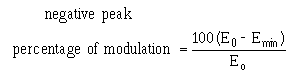
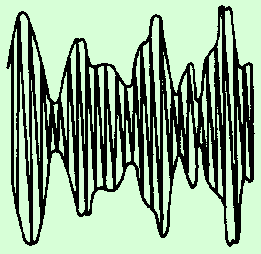
The use of this formula is based on the assumption that the modulating voltage is a pure sine wave. Normal broadcasting, however, is characterized by complex envelope patterns, as illustrated in figure 5-2. In this light, the previous formula is not so clear. Consequently, the preceding formula should be viewed more correctly as the PERCENTAGE OF POSITIVE PEAK MODULATION. When the minimum voltage (E min) rather than the peak voltage (Emax) is used to compute percentage of modulation, the computed percentage (shown below) is the PERCENTAGE OF NEGATIVE PEAK MODULATION:
Figure 5-2. - Rf carrier amplitude-modulated by a complex wave envelope.
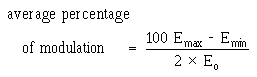
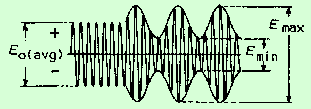
Since the preceding two modulation percentages often differ, you should define the AVERAGE PERCENTAGE OF MODULATION, as shown below (refer to fig. 5-3):
Figure 5-3. - Rf amplitude percentage modulation wave envelope.
From the preceding definitions of percentage of modulation, you should note that methods of measuring all three types of modulation percentages must be devised. When differing values are obtained, however, the cause may not necessarily be directly related to unequal positive and negative peaks of a complex modulation wave. Another possibility is distortion caused by carrier shift. Distortion may also be produced by effects other than the modulation process - for example, parasitic oscillation, nonlinear radio-frequency amplification of modulated signals, and distortion present in the audio amplifiers. Unfortunately, continuous variations in the percentage of modulation create a number of additional problems. For example, damping is necessary so that a meter can provide an average reading despite fluctuations. An average reading, on the other hand, will not disclose the presence of transient overmodulation. This shortcoming is serious because of the large number of sideband frequencies produced in addition to the normal ones whenever overmodulation occurs. Not only do these extra frequencies interfere drastically with other transmissions, but they also may significantly distort the modulation signal. These considerations account for the importance of using a meter that responds to modulation peak; specifically, both positive-peak and negative-peak overmodulation must be indicated. Positive-peak overmodulation occurs when the positive modulation exceeds 100%; negative-peak overmodulation occurs when the negative modulation exceeds 100%. |
 
|
|
|
Integrated Publishing, Inc. - A (SDVOSB) Service Disabled Veteran Owned Small Business
|