Custom Search
|
|
  |
|
|
CHAPTER 2 LEARNING OBJECTIVES Upon completing this chapter, you will be able to:
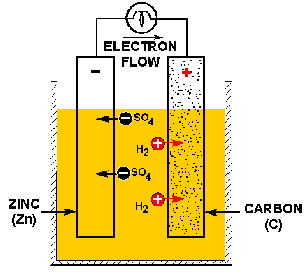
INTRODUCTION The purpose of this chapter is to introduce and explain the basic theory and characteristics of batteries. The batteries which are discussed and illustrated have been selected as representative of many models and types which are used in the Navy today. No attempt has been made to cover every type of battery in use, however, after completing this chapter you will have a good working knowledge of the batteries which are in general use. First, you will learn about the building block of all batteries, the CELL. The explanation will explore the physical makeup of the cell and the methods used to combine cells to provide useful voltage, current, and power. The chemistry of the cell and how chemical action is used to convert chemical energy to electrical energy are also discussed. In addition, the care, maintenance, and operation of batteries, as well as some of the safety precautions that should be followed while working with and around batteries are discussed. Batteries are widely used as sources of direct-current electrical energy in automobiles, boats, aircraft, ships, portable electric/electronic equipment, and lighting equipment. In some instances, they are used as the only source of power; while in others, they are used as a secondary or standby power source. A battery consists of a number of cells assembled in a common container and connected together to function as a source of electrical power. THE CELL A cell is a device that transforms chemical energy into electrical energy. The simplest cell, known as either a galvanic or voltaic cell, is shown in figure 2-1. It consists of a piece of carbon (C) and a piece of zinc (Zn) suspended in a jar that contains a solution of water (H20) and sulfuric acid (H2S04) called the electrolyte.
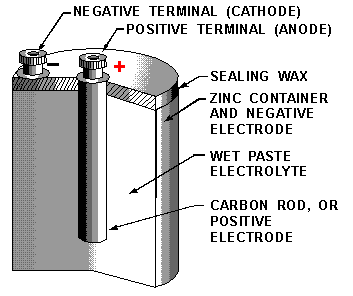
Figure 2-1. - Simple voltaic or galvanic cell. The cell is the fundamental unit of the battery. A simple cell consists of two electrodes placed in a container that holds the electrolyte. In some cells the container acts as one of the electrodes and, in this case, is acted upon by the electrolyte. This will be covered in more detail later. ELECTRODES The electrodes are the conductors by which the current leaves or returns to the electrolyte. In the simple cell, they are carbon and zinc strips that are placed in the electrolyte; while in the dry cell (fig. 2-2), they are the carbon rod in the center and zinc container in which the cell is assembled.
Figure 2-2. - Dry cell, cross-sectional view. ELECTROLYTE The electrolyte is the solution that acts upon the electrodes. The electrolyte, which provides a path for electron flow, may be a salt, an acid, or an alkaline solution. In the simple galvanic cell, the electrolyte is in a liquid form. In the dry cell, the electrolyte is a paste. CONTAINER The container which may be constructed of one of many different materials provides a means of holding (containing) the electrolyte. The container is also used to mount the electrodes. In the voltaic cell the container must be constructed of a material that will not be acted upon by the electrolyte.
|
|