Custom Search
|
|
  |
|
|
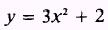
PRACTICE PROBLEMS: 1. Find, by integration, the area under the curve y=x+4 bounded by the X axis and the lines x=2 and x=7 verify this by a geometric process. 2. Find the area under the curve
bounded by the X axis and the lines x = 0 and x = 2 3. Find the area between the curve
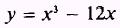
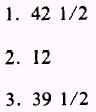
and the X axis, from x = -1 to x = 3 ANSWERS:
SUMMARY The following are the major topics covered in this
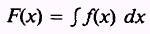
chapter: 1. Definition of integration: Integration is defined as the inverse of differentiation.
where F(x) is the function whose derivative is the
function f(x);
2. Area under a curve:
where
Intermediate
Value Theorem:
where f(c) is the function at an
intermediate point between a and b.
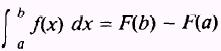
where F(b) - F(a) are the integrals of the
function of the curve at the values b and a. 3. Indefinite integrals:
where C is called a constant of integration, a number which is independent of the variable of integration. Theorem 1. If two functions differ by a constant, they have the
same derivative. Theorem 2. If two functions have the same derivative, their
difference is a constant. 4. Rules for integration:
The integral of a differential of a function is the
function plus a constant.
A constant may be moved across the integral sign. NOTE: A
variable may NOT be moved across the integral sign.
The integral of
The integral of a sum is equal to the sum of the
integrals. 5. Definite integrals:
where b, the upper limit, and a, the
lower limit, are given values. 6. Areas above and below a curve: If the graph of y = f(x), between x = a and x =
b, has portions above and portions below the X axis, then
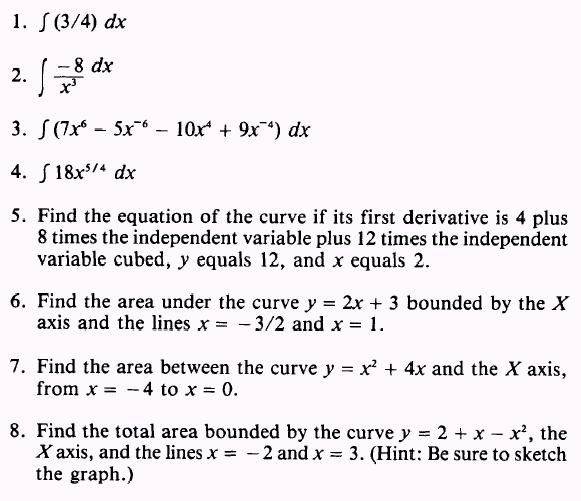
ADDITIONAL PRACTICE PROBLEMS Evaluate the following
integrals:
ANSWERS TO ADDITIONAL PRACTICE PROBLEMS
|
 
|













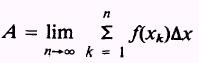
 (sigma) is the symbol for sum,
  is the area of each rectangle, and k is the
designation number of each rectangle.
is the area of each rectangle, and k is the
designation number of each rectangle.





 du may be obtained by adding 1 to the exponent
and then dividing by this new exponent.
du may be obtained by adding 1 to the exponent
and then dividing by this new exponent.