Custom Search
|
|
 
|
||
|
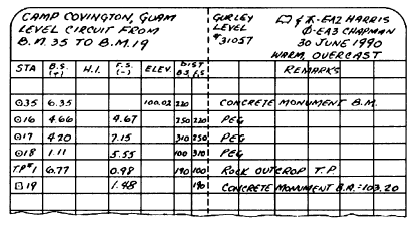
QUESTIONS Q1. What are the two principal methods of indirect leveling?Q2. Refering to figure 7-43, you have determined the slope distance from BM31 to point A to be 404.163 meters. If you disregard corrections for standard error, temperature, and sag, what is (a) the horizontal distance from BM31 to point A and(b) the elevation at point A?Q3. Refer to figure 7-44. What is the error of closure? Is this error of closure satisfactory for third-order leveling?
Figure 7-43.Trigonometric leveling scenario for question Q2.
Figure 7-44.Field notes for a differential-level circuit.
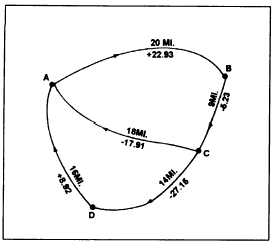
Figure 7-45.Level net for use in answering question Q4. Q4. Refer to the level circuit ABCA shown in figure 7-45. What is (a) the error of closure in the circuit, and (b) the corrected difference in elevation (cycle I) for line AB? Q5. What is the latitude of a 300-foot traverse line running due east and west? Q6. Assume that you are working with a traverse that has a total length of 2,541.35 feet, an error of closure in latitude of 1.73 feet, and an error of closure in departure of +2.01 feet. What is the ratio of error of closure? Q7. Compute the bearing of traverse line AB when the coordinates of station A and B are follows: Station A: X = 627.42, Y= 326.87 Station B: X = 864.81, Y= 542.50 Q8. Refer to figure 7-46. What is the approximate area contained within the traverse?
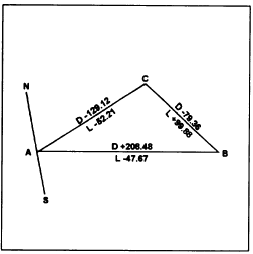
Figure 7-46.Closed traverse for use with question Q8. A1. Barometric leveling and trigonometric leveling. A2. (A) 398.303 meters, (B) 46.506 meters. (If your answer to Part A is incorrect, then you should review Engineering Aid 3, pages 12-18 and AIII-13.)A3. (A) 0.08 feet, (B) no. A4. (A) 0.21 feet, (B) +23.02 feet. A5. 0 feet. A6. 1/959 (or 1/1,000). A7. N4745E. A8. 8,520 square feet. |
 
|
|
|
||