CADENCES
Primary triads in root position may be used to form three types of harmonic cadences:
AUTHENTIC.
PLAGAL.
HALF. Authentic Cadence
An authentic cadence occurs when the dominant chord progresses to the tonic chord at a cadence point. In a Perfect Authentic cadence, both chords are in root position and the tonic scale degree appears in the Soprano voice over the tonic chord. The Perfect Authentic occurs most often as a final cadence.
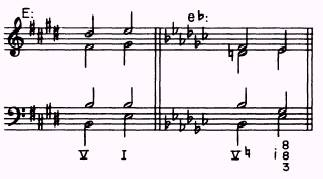 FIGURE 5.10: Perfect Authentic Cadences
In an Imperfect Authentic cadence, either chord is inverted, and/ or the root is not in the Soprano on the tonic chord. The Imperfect Authentic cadence occurs most often at cadence points other than final.
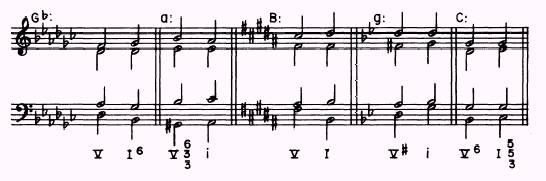 FIGURE 5.11: Imperfect Authentic Cadences
Occasionally, in a Perfect Authentic cadence, the leading tone may DROP to the fifth of the tonic chord when it is in the Alto or Tenor voices. This is usually a result of supersonic to
tonic voice leading in the Soprano voice. It is written this way to allow all notes of the chord to appear.
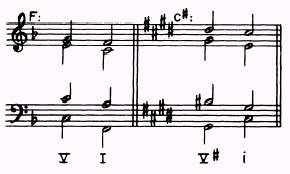 FIGURE 5.12: Leading Tone Dropping in a Perfect Authentic Cadence
Plagal Cadence
A Plagal cadence occurs when the subdominant chord progresses to the tonic chord at a cadence point. In a Perfect Plagal cadence, both chords are in root position and the tonic scale degree appears in the Soprano voice over both chords.
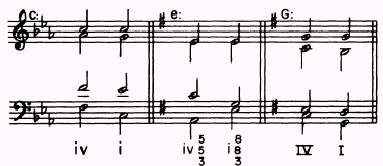 FIGURE 5.13: Perfect Plagal Cadence
In an Imperfect Plagal cadence, either chord is inverted, and/ or the root is not in the Soprano on the tonic chord. Plagal cadences often follow final authentic cadences to emphasize finality.
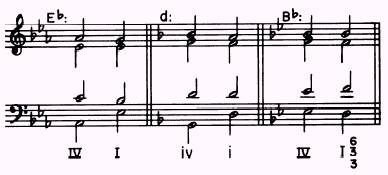 FIGURE 5.14: Imperfect Plagal Cadences
Half Cadence
A Half cadence (Semi-cadence) occurs when any chord, regardless of inversion, progresses to the dominant at a cadence point. Generally, the dominant chord will be in root position. A Plagal Half cadence occurs when any chord, regardless of inversion, progresses to the subdominant at a cadence point. Generally, the subdominant chord will be in root position. Half cadences are not used as final cadences.
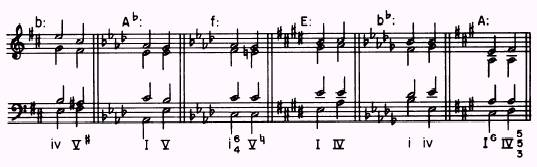 FIGURE 5.15: Half Cadences
Picardy Third (Tierce de Picardie)
Occasionally, the tonic triad in minor will be borrowed from its parallel major at an authentic cadence. This is known as a Picardy Third (Tierce de Picardie) and occurs at final
cadences. When figured bass is used, it must reflect the alteration that occurs.
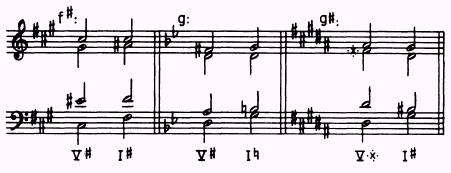
FIGURE 5.16: Picardy Third
|