| Tweet |

Custom Search
|
|
 
|
||
|
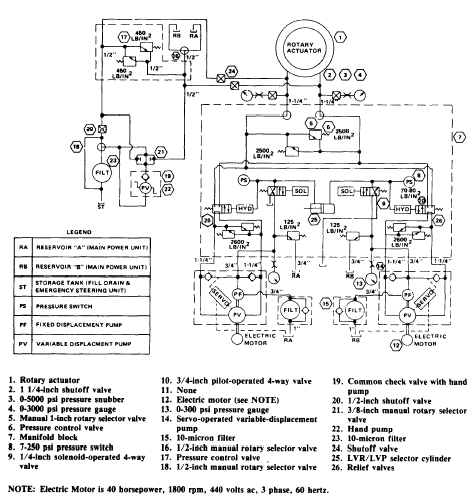
Graphic Diagrams The primary purpose of a graphic (schematic) diagram is to enable the maintenance person to trace the flow of fluid from component to component within the system. This type of diagram uses standard symbols to show each component and includes all interconnecting piping. Additionally, the diagram contains a component list, pipe size, data on the sequence of operation, and other pertinent information. The graphic diagram (fig. 12-3) does not indicate the physical location of the various components, but it does show the relation of each component to the other components within the system.
Figure 12-3.Graphic diagram of LST 1182 class hydraulic steering gear. Notice that figure 12-3 does not indicate the physical location of the individual components with respect to each other in the system. For example, the 3/4-inch, solenoid-operated, 4-way valve (10) is not necessarily located directly above the relief valve (26). The diagram does indicate, however, that the 4-way valve is located in the working line, between the variable-displacement pump and the 1-inch rotary selector valve, and that the valve directs fluid to and from the rotary actuator.Combination Diagrams A combination drawing uses a combination of graphic, cutaway, and pictorial symbols. This drawing also includes all interconnecting piping.A fluid power system in which the fluid in the system remains pressurized from the pump (or regulator) to the directional control valve while the pump is operating is referred to as a closed-center system. In this type of system, any number of subsystems may be incorporated, with a separate directional control valve for each subsystem. The directional control valves are arranged in parallel so that system pressure acts equally on all control valves.Another type of system that is sometimes used in hydraulically operated equipment is the open-center system. An open-center system has fluid flow but no internal pressure when the actuating mechanisms are idle. The pump circulates the fluid from the reservoir, through the directional control valves, and back to the reservoir. (See fig. 12-4, view A.) Like the closed-center system, the open-center system may have any number of subsystems, with a directional control valve for each subsystem. Unlike the closed-center system, the directional control valves of an open-center system are always connected in series with each other, an arrange-ment in which the system pressure line goes through each directional control valve. Fluid is always allowed free passage through each control valve and back to the reservoir until one of the con-trol valves is positioned to operate a mechanism. When one of the directional control valves is positioned to operate an actuating device, as shown in view B of figure 12-4, fluid is directed from the pump through one of the working lines to the actuator. With the control valve in this position, the flow of fluid through the valve to the reservoir is blocked. Thus, the pressure builds up in the system and moves the piston of the
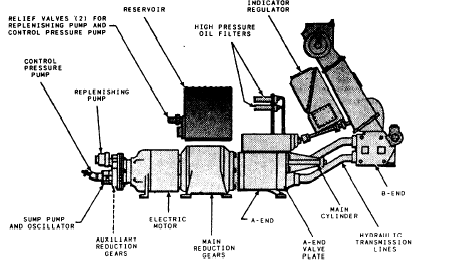
Figure 12-4.Open-center hydraulic system. actuating cylinder. The fluid from the other end of the actuator returns to the control valve through the opposite working line and flows back to the reservoir.Several different types of directional control valves are used in the open-center system. One type is the manually engaged and manually disengaged. After this type of valve is manually moved to the operating position and the actuating mechanism reaches the end of its operating cycle, pump output continues until the system relief valve setting is reached. The relief valve then unseats and allows the fluid to flow back to the reservoir. The system pressure remains at the pressure setting of the relief valve until the directional control valve is manually returned to the neutral position. This action reopens the open-center flow and allows the system pressure to drop to line resistance pressure. Another type of open-center directional control valve is manually engaged and pressure disengaged. This type of valve is similar to the valve discussed in the preceding paragraph; however, when the actuating mechanism reaches the end of its cycle and the pressure continues to One of the advantages of the open-center system is that the continuous pressurization of the system is eliminated. Since the pressure is gradually built up after the directional control valve is moved to an operating position, there is very little shock from pressure surges. This provides a smooth operation of the actuating mechanisms; however, the operation is slower than the closed-center system in which the pressure is available the moment the directional control valve is positioned. Since most applications require instantaneous operation, closed-center systems are the most widely used.HYDRAULIC POWER DRIVE SYSTEM The hydraulic power drive has been used in the Navy for many years. Proof of its effectiveness is that it has been used to train and elevate nearly all caliber guns, from the 40-mm gun mount to the 16-inch turret. In addition to gun mounts and turrets, hydraulic power drives are used to position rocket launchers and missile launchers, and to drive and control such equipment as windlasses, capstans, and winches. In its simplest form, the hydraulic power drive consists of the following:1. The prime mover, which is the outside source of power used to drive the hydraulic pump2. A variable-displacement hydraulic pump 3. A hydraulic motor 4. A means of introducing a signal to the hydraulic pump to control its output5. Mechanical shafting and gearing that transmits the output of the hydraulic motor to the equipment being operated Hydraulic power drives differ in some respects, such as size, method of control, and so forth. However, the fundamental operating principles are similar. The unit used in the following discussion of fundamental operating principles is representative of the hydraulic power drives used to operate the 5"/38 twin mounts. Figure 12-5 shows the basic components of the train power drive. The electric motor is constructed with drive shafts at both ends. The forward shaft drives the A-end pump through reduction gears, and the after shaft drives the auxiliary pumps through the auxiliary reduction gears. The reduction gears are installed because
Figure 12-5.-Train power drivecomponents. the pumps are designed to operate at a speed much slower than that of the motor.The replenishing pump is a spur gear pump. Its purpose is to replenish fluid to the active system of the power drive. It receives its supply of fluid from the reservoir and discharges it to the B-end valve plate. This discharge of fluid from the pump is held at a constant pressure by the action of a pressure relief valve. (Because the capacity of the pump exceeds replenishing demands, the relief valve is continuously allowing some of the fluid to flow back to the reservoir.)The sump pump and oscillator has a twofold purpose. It pumps leakage, which collects in the sump of the indicator regulator, to the expansion tank. Additionally, it transmits a pulsating effect to the fluid in the response pressure system. Oscillations in the hydraulic response system help eliminate static friction of valves, allowing hydraulic control to respond faster. The control pressure pump supplies high-pressure fluid for the hydraulic control system, brake pistons, lock piston, and the hand-controlled clutch operating piston. The control pressure pump is a fixed-displacement, axial-piston type. An adjustable relief valve is used to limit the operating pressure at the outlet of the pump. |
 
|
|
|
||