Custom Search
|
|
 
|
||
|
TYPES OF TEETH Man is omnivorous, so his teeth are formed for cutting, tearing, and grinding food. The human permanent dentition is divided into four classes of teeth based on appearance and function or position. Figure 4-11 illustrates the types and working surfaces of the four classes of teeth. Incisors Incisors are named because they are used to incise food. They are located in the front of the mouth and have sharp, thin edges for cutting. The lingual surface can have a shovel-shaped appearance.
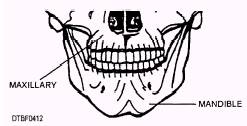
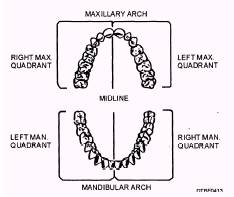
Figure 4-11.\Working surfaces of human teeth. Cuspids cuspids, also referred to as canines, are at the angles of the mouth. Each has a single cusp in stead of an incisal edge and are designed for cutting and tearing. Bicuspids Bicuspids, also referred to as premolars, are similar to the cuspids. They have two cusps used for cutting and tearing, and an occlusal surface that is wider to crush food. Molars Molars are located in the back of the mouth; their size gradually gets smaller from the first to third molar. Each molar has four or five cusps, is shorter and more blunt in shape than other teeth and provides a broad surface for grinding and chewing solid masses of food. DENTAL ARCHES The teeth of the upper arch are called maxillary teeth, (fig. 4-12) because their roots are embedded within the alveolar process of the maxilla. Those of the lower arch are called mandibular teeth because their roots are embedded within the alveolar process of the mandible. Each arch contains 16 teeth. The teeth in an arch are composed of 6 anteriors (cuspid to cuspid) and 10 posterior (all teeth distal to the cuspids). In a quadrant, there are 3 anterior and 5 posterior teeth. DENTAL QUADRANTS Each dental arch is divided into a right and a left quadrant. The quadrants are formed by an imaginary line called the midline that passes between the central incisors in each arch and divides the arch in half (fig. 4-13). There are four quadrants in the mouth (two
Figure 4-12.\Maxillary and mandibular arches showing relationship of the bones and teeth.
Figure 4-13.\Maxillary and mandibular arches divided into quadrants. per arch) that divide the mouth into four equal parts. Quadrant means one fourth, and each quadrant is one fourth of the entire mouth. Teeth are described as being located in one of the four quadrants: right maxillary quadrant, left maxillary quadrant, right mandibular quadrant, or the left mandibular quadrant. |
 
|
|
|
||