Oxygen must never be used near open flames since
it supports burning. Oxygen cylinders must be handled
carefully since they are potentially lethal missiles if
punctured or broken.
ARTIFICIAL AIRWAYS
The oropharyngeal and nasopharyngeal airways
are primarily used to keep the tongue from occluding
(closing) the airway.
Oropharyngeal Airway
The oropharyngeal airway can be used only on
unconscious victims because a conscious person will
gag on it. This airway comes in various sizes for
different age groups and is shaped to rest on the
contour of the tongue and extend from the lips to the
pharynx.
Selecting the correct size oropharyngeal
airway is very important to its effectiveness.
An
airway of proper size will extend from the corner of the
patient’s mouth to the tip of the earlobe on the same
side of the patient’s face.
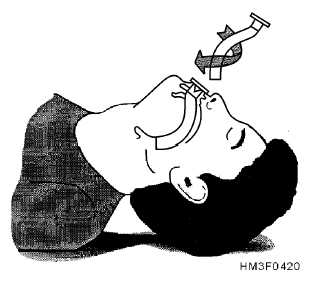
One method of insertion is to depress the tongue
with a tongue blade and slide the airway in. Another
method is to insert the airway upside down into the
victim’s mouth; then rotate it 180 as it slides into the
pharynx (fig. 4-20).
Nasopharyngeal Airway
The nasopharyngeal airway may be used on
conscious victims since it is better tolerated because it
generally does not stimulate the gag reflex. Since it is
made of flexible material, it is designed to be
lubricated and then gently passed up the nostril and
down into the pharynx.
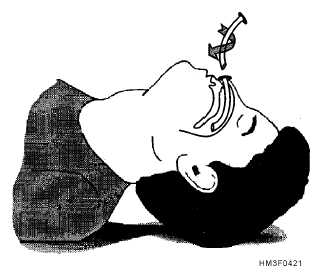
If the airway meets an
obstruction in one nostril, withdraw it and try to pass it
up the other nostril.
See figure 4-21 for proper
insertion of the nasopharyngeal airway.
BAG-VALVE MASK VENTILATOR
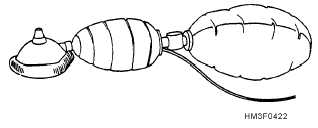
The bag-valve mask ventilator (fig. 4-22) is
designed to help ventilate an unconscious victim for
long periods while delivering high concentrations of
oxygen. This system can be useful in extended CPR
attempts because, when using external cardiac
compressions, the cardiac output is cut to 25 to 30
percent of the normal capacity, and artificial
ventilation does not supply enough oxygen through the
circulatory system to maintain life for a long period.
Various types of bag-valve-mask systems that
come in both adult and pediatric sizes are in use in the
Navy.
Essentially, they consist of a self-filling
ventilation bag, an oxygen reservoir, plastic face
masks of various sizes, and tubing for connecting to an
oxygen supply.
4-26
Figure 4-20.—The rotation method of inserting an
oropharyngeal airway.
Figure 4-21.—Proper insertion of a nasopharyngeal airway.
Figure 4-22.—Bag-valve mask ventilator.