circulation, reproduction, excitability, and movement.
Protoplasm, thus, has often been called “the secret of
life.”
A typical cell is made up of the plasma membrane,
the nucleus, and the cytoplasm.
The plasma membrane is a selectively permeable
membrane surrounding the cell. In addition to holding
the cell together, the membrane selectively controls the
exchange of materials between the cell and its
environment by physical and chemical means. Gases
(such as oxygen) and solids (such as proteins,
carbohydrates, and mineral salts) pass through the
plasma membrane by a process known as diffusion.
The nucleus is a small, dense, usually spherical
body that controls the chemical reactions occurring in
the cell. The substance contained in the nucleus is
called nucleoplasm. The nucleus is also important in
the cell's reproduction, since genetic information for
the cell is stored there. Every human cell contains 46
chromosomes, and each chromosome has thousands of
genes that determine the cell's function.
The cytoplasm is a gelatinous substance
surrounding the nucleus and is contained by the plasma
membrane. The cytoplasm is composed of all of the
cell protoplasm except the nucleus.
The simplest living organism consists of a single
cell. The amoeba is a unicellular animal. The single
cell of such a one-celled organism must be able to carry
on all processes necessary for life. This cell is called a
simple or undifferentiated cell, one that has not
acquired distinguishing characteristics.
In multicellular organisms, cells vary in size,
shape, and number of nuclei. When stained, the various
cell structures can be more readily recognized under a
microscope. Other differences such as the number and
type of cells can be seen with the aid of a microscope.
Many cells are highly specialized. Specialized cells
perform special functions (e.g., muscle cells, which
contract, and epithelial cells, which protect the skin).
TISSUES
LEARNING OBJECTIVES:
Identify the
types of tissues in the human body and their
functions.
Tissues are groups of specialized cells similar in
structure and function. They are classified into four
main groups: epithelial, connective, muscular, and
nervous.
EPITHELIAL TISSUE
The lining tissue of the body is called epithelium.
It forms the outer covering of the body known as the
free surface of the skin. It also forms the lining of the
digestive, respiratory, and urinary tracts; blood and
lymph vessels; serous cavities (cavities which have no
communication with the outside of the body, and
whose lining membrane secretes a serous fluid), such
as the peritoneum or pericardium; and tubules (small
tubes which convey fluids) of certain secretory glands,
such as the liver and kidneys. Epithelial tissues are
classified according to their shape, arrangement, and
the function of their cells. For example, epithelial
tissues that are composed of single layers of cells are
called “simple,” while cells with many layers are said
to be “stratified.” In the following paragraphs we will
discuss the three categories of epithelial tissue:
columnar, squamous, and cuboidal.
Columnar Epithelial Tissue
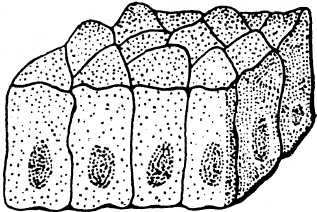
Epithelial cells of this type are elongated, longer
than they are wide. Columnar tissue is composed of a
single layer of cells whose nuclei are located at about
the same level as the nuclei in their neighboring cells
(fig. 1-3). These cells can be located in the linings of
the uterus, in various organs of the digestive system,
and in the passages of the respiratory system. In the
digestive system, the chief function of columnar tissue
is the secretion of digestive fluids and the absorption of
nutrients from digested foods. In certain areas (such as
the nostrils, bronchial tubes, and trachea), this tissue
has a crown of microscopic hairlike processes known
as cilia. These cilia provide motion to move secretions
1-3
HM3F0103
Figure 1-3.—Columnar epithelial tissue.