

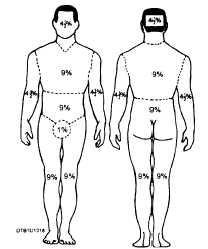
Figure 13-16. - Rules of nine.
The head and neck
The front of each leg
The back of each leg
The chest
The abdomen
The upper back
The lower back and buttocks
As a general rule, all third-degree burns should be regarded as serious, as should first-degree and second-degree burns that cover more than 15 percent of a casualty’s body. All facial burns should also be regarded as serious.
A casualty with a serious burn will usually be experiencing shock, and the patient's life may be in danger.
The casualty must receive emergency treatment immediately. You should then get medical assistance or transport the casualty to an aid station as soon as possible.
Thermal Burns. - If a casualty is suffering from a serious thermal burn, you should take the following steps:
1. Ensure there is an open airway.
2. Treat to prevent infection.
3. Treat for shock.
Ensure there is an open airway. Hot gases or smoke may have caused the casualty's airway to swell shut.
Tilt the casualty's head to the chin-up position. If the casualty is not breathing, apply artificial ventilation. If the casualty is breathing but has facial burns, place the casualty in a sitting position if this makes breathing easier.
TREAT TO PREVENT INFECTION. - Cover the entire burned area with a sterile dressing.
Do not put ointments, antiseptics, or other medications on
a burn. These will interfere with later treatment. To prevent infection of the burn, you must observe the following precautions:
Never allow any unsterile objects or material to come into contact with the burn. (However, in an emergency situation when no sterile dressing is available, you may cover the burn with a clean sheet or an unused plastic bag.) Never use rough textured materials like blankets to cover the burn.
Never attempt to break blisters.
Never attempt to remove shreds of tissue or charred clothing from the burn.
For thermal burns of the eye, make sure that the casualty does not rub the eyes.
Cover each eye with a small, moist, thick compress.
Fasten the compress in place with a bandage. Treat the casualty for shock. To treat for shock, maintain the casualty's body heat, but do not allow the casualty to become overheated.
If the casualty is in severe pain, you may administer morphine, but only under the mass casualty conditions discussed earlier. A seriously burned casualty has an overwhelming need for liquids.
If the casualty is conscious, has no internal injuries, and is not vomiting, prepare a weak solution of salt (1 teaspoon) and baking soda (1/2 teaspoon) in a quart of warm water.
Allow the casualty to sip slowly.
Chemical Burns. - Corrosive chemicals that come in contact with body tissues may cause chemical burns. To treat acasualty with a serious chemical burn, take the following steps:
1. Immediately flush the burned area with large amounts of water. Pour water over the area; use a hose or shower if one is available.
Do not apply water too forcefully, because this could further damage the burned tissue. While the area is being flushed, remove the casualty's clothing, including the shoes and socks.
Keep flushing the area until all traces of the chemical have been removed.
2. Gently pat the burned area with sterile gauze. Do not rub the area with the gauze.
Be careful not to break the skin or open any blisters.
3. Prevent infection by covering the entire burned area with a sterile dressing, just as you would for a thermal burn.Continue Reading